

Shobha Yadav, Chairman Women Wing CNRI –
New Delhi, 4 October 2026
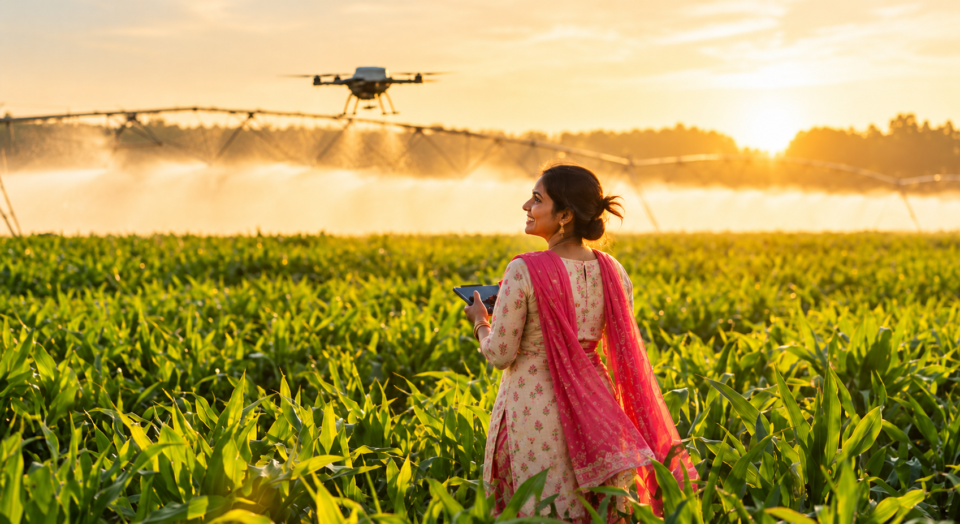
For generations, the woman farmer of India has looked up at the sky with one question: will it rain? She has bent over the furrows before sunrise, stood knee-deep in paddy water, and carried seed, fodder, water and the family’s hopes on the same tired shoulders. She knows every inch of her field, yet the tractor, the title deed and the technology have almost always been in someone else’s name. She has fed the nation, and the nation has rarely noticed her. From tomorrow, twenty-five such women will look up at the sky with a different question: where shall I fly today?
On 5 October, FlySakhi – Drone Queens of Bharat begins its first training cohort, preparing twenty-five women from farming families to become certified drone pilots. The initiative is being carried out under the leadership of Shri Dileep Sanghani, Chairman of the World Cooperative Economic Forum (WCOOPEF), and is being executed by Ms. Shobha Yadav, Chairman of the Women Wing of the Confederation of NGOs of Rural India (CNRI). It is a flagship digital initiative of CNRI’s Civil Society Resilience and National Awareness Mission (CSRNAM), built as a consortium in which every partner brings what it does best. CNRI and WCOOPEF bring the mission and the cooperative vision. The TiHAN alliance at IIT Hyderabad brings the technology. The Alumni Association of PGDCBM Officers of VAMNICOM brings cooperative management expertise. Syngenta, through its corporate social responsibility, brings the support and the conviction that make the whole journey possible. No single institution could have done this alone, and that is exactly the point: FlySakhi is cooperation in action, a consortium created to help women build cooperatives of their own.
Syngenta’s role in this story deserves special mention. As one of the world’s leading agricultural science and technology companies, with long experience in crop protection and seeds and a deep presence among Indian farmers, Syngenta understands better than most that the future of farming will be shaped by precision, safety and the people in the field. By choosing to invest its CSR in rural women rather than in machines alone, Syngenta has made a statement that technology delivers its full promise only when it is placed in the right hands, and that those hands increasingly belong to women. Its support reflects a commitment to smallholder prosperity, to the safe and responsible use of crop inputs, and to the adoption of precision application technologies such as drones, which use less water, reduce wastage and protect the health of the farmer.
FlySakhi shows what responsible corporate partnership can look like at its best: an industry leader standing alongside civil society, cooperatives and academia to build capability that stays in the village long after the training ends.
Shri Sanghani’s leadership gives the initiative both depth and reach. Recently elected At-Large Director of the International Cooperative Alliance Global Board for the 2026–2030 term, he brings the strength of the cooperative movement at home and abroad. He also serves on the Prime Minister’s High-Power Committee on MSP, Crop Diversification and Natural Farming, and through WCOOPEF he guides a new generation of cooperators in advancing cooperative economics as a pathway to inclusive and self-reliant growth. On the ground, Ms. Shobha Yadav and the CNRI Women Wing have shaped the programme around the real lives of rural women. They have selected the trainees, planned the schedule and made sure that every woman who joins is cared for from the first online class to the final flight.
The initiative draws its inspiration from the Namo Drone Didi initiative of the Hon’ble Prime Minister, Shri Narendra Modi. That initiative set out to equip women’s self-help groups with agricultural drones so they could offer drone services to farmers and earn a steady additional income, and it showed the country that a rural woman can confidently handle advanced technology.
FlySakhi seeks to strengthen this national effort from the civil-society and cooperative side by identifying motivated women from farming families, training them to a professional standard and connecting them to credit and cooperative institutions so that their skills turn into lasting enterprises. It also comes at a fitting moment, since the United Nations has declared 2026 the International Year of the Woman Farmer. Women do a very large share of the work in Indian agriculture, yet they are rarely the ones who own the machine, hold the licence or make the technology decisions. FlySakhi turns that recognition into ownership, because when a woman flies the drone over her own village’s fields, she stops being an unseen labourer and becomes a skilled service provider.
At its heart, FlySakhi is a digital initiative to bring the Cooperative Economic Framework (CEF) to the village. The CEF holds that rural prosperity is most secure when productive assets, services and data stay in the hands of the community, governed by its members and run through transparent local markets. Left to the open market, drone services could easily be concentrated in a few outside operators, but under the CEF they become a shared community asset. The trained pilots will be encouraged to organise as women’s drone-service collectives, or to work through their self-help groups, FPOs and Primary Agricultural Credit Societies. In this way drones can be owned jointly, booked by member farmers at fair and transparent rates, and financed through cooperative banks. Every flight also produces valuable farm data on crop health, field boundaries and input use, and under the CEF this data belongs to the farmers and their cooperative rather than to intermediaries. This approach is consistent with the National Cooperation Policy’s emphasis on transparent, digitally enabled cooperatives and with the national vision of Sahkar Se Samriddhi. It is also where FlySakhi meets the purpose of CSRNAM. A nation is only as resilient as its villages, and a village is only as resilient as its women. A community that owns its technology, controls its data and earns from its own skills is far harder to exploit, mislead or make dependent, and that is civil-society resilience in its truest sense, in step with the vision of Viksit Bharat 2047.
The programme opens with a virtual inauguration on 5 October, followed by combined online theory classes for all twenty-five trainees on 5 and 6 October. Physical training then takes place at the Remote Pilot Training Organisation in three batches of three days each, covering simulator practice and hands-on flying, with WOW Green as the training partner. The women are being provided twin-sharing accommodation with all facilities and transport to and from the training venue. The first two batches will also spend two hours at IIT Hyderabad, home to TiHAN, the Technology Innovation Hub on Autonomous Navigation. TiHAN was established under the Department of Science and Technology’s National Mission on Interdisciplinary Cyber-Physical Systems and hosts India’s first dedicated testbed for autonomous navigation systems, covering both aerial drones and ground vehicles. Through the TiHAN alliance, the trainees will learn that a drone is far more than a sprayer. It can apply nutrients and crop protection products with precision, saving water, inputs and the farmer’s own health. It can also monitor crop health, map fields, survey land, assess crop loss for insurance claims after floods or pest attacks, and carry small loads to remote areas. Each of these is a separate income stream, and together they can make a trained woman pilot an essential service provider for her entire village cluster. For women who have spent their lives in the fields, a walk through IIT Hyderabad carries a quiet but powerful message: the most advanced technology in the country is meant for them too.
Turning that technology into a lasting livelihood is where the Alumni Association of PGDCBM Officers of VAMNICOM plays its part. VAMNICOM, the Vaikunth Mehta National Institute of Cooperative Management in Pune, is India’s apex institute for cooperative education, training and research and functions under the Ministry of Cooperation, Government of India. Its alumni serve across cooperative banks, federations, marketing societies, dairy and fertiliser cooperatives, government departments and development organisations, and they will help the women form and run drone-service collectives and connect them with cooperative credit. That credit becomes possible because the certificate each trainee earns will be bankable: banks and financial institutions will be able to accept it as proof of professional competence when considering loans for a drone or a drone-service enterprise. For a rural woman with little collateral, this is the bridge from training to an income of her own.
The consortium is deeply grateful to Syngenta, whose generous support and belief in rural women have turned this idea into a reality, and whose partnership sets an example that the wider agricultural industry would do well to follow. It is equally grateful to TiHAN–IIT Hyderabad for its technology partnership and to the VAMNICOM PGDCBM alumni for their cooperative expertise. Above all, it is grateful to the twenty-five women who have had the courage to say yes.
There is an old saying in the village that a woman’s place is in the home. The FlySakhis are about to show that her place is wherever she chooses to fly, and these days that is about thirty feet above the crop canopy, holding a remote control and a business plan. What takes off this week is not merely twenty-five drones. It is a woman who will now quote a fair rate for her services instead of waiting for a wage, a daughter who will hear her mother called “pilot” and decide there is nothing she cannot become, and a village whose fields, data and income stay in its own hands. The dream of this consortium is simple and entirely achievable: a FlySakhi in every agricultural block of India, organised into women’s cooperatives, financed by cooperative banks and trusted by every farmer around her. When India celebrates a hundred years of independence in 2047, the hope is that the story of its rise will include a chapter written in the sky by the women who once only looked up at it to pray for rain. The sky has said yes, and now it is the nation’s turn to say yes to them.
Ms. Shobha Yadav, Chairman, Women Wing, Confederation of NGOs of Rural India (CNRI), which holds Special Consultative Status with the UN ECOSOC.
