

By Binod Anand
A slogan born on a Paris barricade. A youth federation’s roll call in Athens. A summit speech in New York. A lockdown at Jantar Mantar. And at the Indian end of the thread, again and again, Kerala. The steps are many; the rhythm is one. Every choreography needs more than dancers. It needs a rehearsal hall, trained performers, a script and someone who knows the beat. In the Indian chapter of this autumn’s unrest, Kerala supplies more of these than any other state — not by conspiracy, but by capacity. Kerala is where India’s organised student politics is oldest and most chaotic. It is where the transnational Left finds its most quoted revolts against establishments, a Kerala Congress unethically casted aspersion on Hon’ble Supreme court is recent one . And it is where a freshly defeated political movement now holds cadre, networks and grievance with nowhere electoral to spend them.
Put those three together and you do not have a command centre. You have an engine room. In the first part of this series, I described the choreography of chaos: the way grievances in one country are lifted, set to a common rhythm and staged in another. The trigger was France, where October’s student blockades and street violence drew international reporting — Fox News Digital among others counted some 101 organisations amplifying the unrest.
Voice of Rural India’s research desk has organised those names into a public, source-attributed register. Most have no India link at all. But when I pulled the few Indian threads to their ends, I found myself, again and again, standing in Kerala. One rhythm, many dancers Begin with the youth.
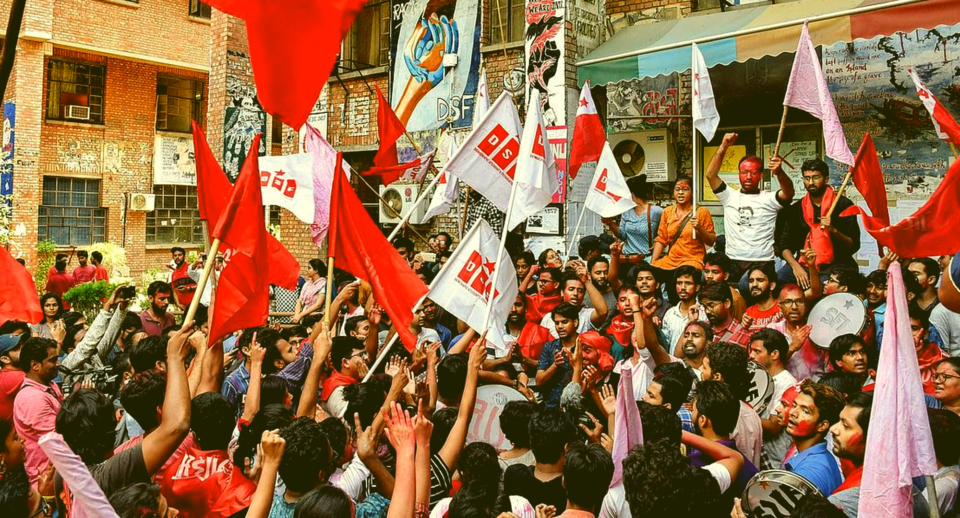
The register notes that the World Federation of Democratic Youth — to which Greek and German communist youth groups on the European list belong — counts four Indian members: SFI, DYFI, AISF and AIYF. These are the student and youth wings of the CPI(M) and the CPI, and nowhere are they more rooted, more chaotic at street mobilisation than in Kerala. A membership roll is not a chain of command. I say this plainly, because the reader deserves honesty more than drama. But watch what these organisations did at home in the very weeks Europe burned. On 10 October, as Delhi was locked down to stop the CJP’s march against the Chief Election Commissioner, an SFI state committee member told Al Jazeera that its Delhi office had been watched for hours before members slipped out to protest. Months earlier, The Federal had reported DYFI backing CJP-inspired rallies across Tamil Nadu. An online satire born on 16 May had found its foot agents— and they came from the most experienced cadre stables in the country. Then follow the ideas.
The one organisation on the European list with a direct, documented India engagement is Progressive International. According to the register, its 16 October briefing placed France, Spain, India and Albania side by side as “new rebellions”, named the CJP alongside SFI, AISF and AISA, and declared these were the forces it worked to support and connect. Read that twice. A transnational network, speaking from outside India, publicly announcing its intent to connect Indian student movements to a European wave. Here the Kerala thread surfaces again — not as cadre, but as credibility. In December 2022, former Kerala finance minister Dr T.M. Thomas Isaac addressed Progressive International’s New York summit on a new international economic order.
Dr Isaac also writes for LeftWord Books, whose chief editor Vijay Prashad has interviewed him; Prashad’s Tricontinental sits at the edge of a separate American controversy over the Singham network, an allegation BreakThrough News rejects. None of this is illegal. Economists speak at summits; publishers interview authors. But it explains why, when the global Left looks for an Indian chapter in its story of rebellion, it finds the “Kerala model” waiting — ready-made vocabulary, ready-made heroes, ready-made proof. The wound that makes room Why now? Because Kerala’s Left is wounded, and wounded movements look for the street. In April, the people of Kerala voted decisively.

The Congress-led UDF won 102 of 140 seats; the CPI(M)-led LDF, which had governed for a decade, was reduced to 35. On 18 May, V.D. Satheesan took the oath. Since then the defeated party has turned on itself, with Dr Isaac publicly pushing back against blaming supporters and urging the party to look inward. But a party can lose an Assembly and keep its campuses. It keeps its youth cadre, its international friendships, its organisational muscle. The question I put to my readers — a question, not a verdict — is where that idle muscle goes. When Pinarayi Vijayan, Chief Minister of Kerala until May, was among those detained in Delhi on 10 October during the CJP crackdown, the answer began to sketch itself. The connection is not dormant. It is in motion. Nor does the thread belong to one party. Kerala is now governed by the Congress, and the register records that Progressive International met Sonia and Rahul Gandhi in April 2025. The choreography does not care which flag flies over the Secretariat. It cares only that the stage is lit. How the connection works Watch the sequence and the role of each part becomes clear.
First a grievance appears — a paper leak, a disputed voter roll. Satire turns it into a symbol, and the cockroach becomes a meme. Then the meme needs bodies, and the bodies come from the cadre: SFI members slipping out of a watched office in Delhi, DYFI backing rallies across Tamil Nadu. Then the bodies need meaning, and meaning arrives from abroad: a briefing in which India’s student movements are filed beside France’s barricades as one “rebellion”.
Finally the movement needs stature, and senior leaders — among them a former Chief Minister of Kerala — stand in the line of detention, lending a youth protest the weight of a national cause. At every step, the Kerala Left is present: as the cadre that mobilises, as the intellectual voice the global network quotes, and as the political leadership that lends gravitas. That is what I mean by an active connection. Not orders from Paris, but a living circuit through which grievance, cadre and global narrative flow into one another, each feeding the next. I do not doubt that most young people in these crowds are sincere. Their anger about jobs, examinations and trust in institutions is real; I hear it in villages across rural India. That is precisely what makes them precious — and precisely what makes them vulnerable. Fourth-generation conflict does not manufacture anger. It harvests it. The case against my own argument Honesty demands that I state the opposing case at full strength. No document I have seen links any Kerala organisation to planning, funding or directing a single event in France. A federation roll and a summit speech are not a conspiracy. The CJP grew on Indian grievances — paper leaks, then the voter roll — not on instructions from Paris. Indian commentators have rightly warned that shared positions do not prove a single command, and the foreign reporting on France carries its own ideological frame. Questioning an electoral exercise is protected speech under our Constitution. These objections are real, and they set the limits of what I claim. They do not erase the pattern: the same organisations, the same networks and the same vocabulary, converging in the same weeks, on the same state. Suspect the technique, never the person So what should Kerala — and India — do? Not suppress. Never suppress. The answer to choreography is literacy. Check the local facts before you march against them. Ask which federation a banner belongs to, and what that federation has said about India. Separate the sincere crowd from those who stage it. And demand transparency symmetrically — of every side, including those of us who publish registers and columns like this one. Kerala gave India its proudest proof that an educated, organised people can hold power to account. That same people, more than anyone, can recognise when their own energy is being set to someone else’s music. The music is already playing. Let us listen carefully to who is playing it.
Right of reply: every organisation and person named here is invited to respond at cnrigreenworld@gmail.com. Responses will be published in full.

1 comment
[…] The Choreography of Chaos-Part 2 KERALA connection […]