

Who Organised Europe’s Autumn of Fire, and Why Intelligence Agencies Missed It?
Oct 24, 2026 An investigative note: Binod Anand, New Delhi.
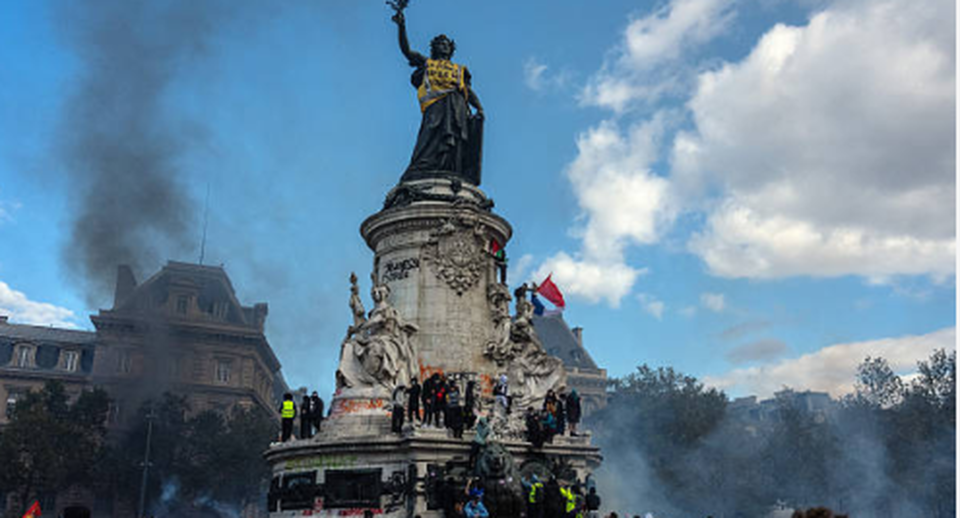
Picture a mother in Paris on the night of Oct 17, 2026. She is waiting for her 16-year-old son who left that morning to protest about a leaking roof in his classroom and a teacher who never showed up. By evening, the boulevard outside his school was ablaze with burning trash cans. In Limoges, a town hall that had been there for generations was “largely lost” to fire. Children who had marched for better schools went home with tear gas in their lungs, and more than 800 people were arrested. Regardless of your politics, the people who paid first were the young, the shopkeeper whose shutters were torn off, and the ordinary family that just wanted their streets back. This is why the question at the heart of this note is so important. Was this an explosion of anger, or was it coordinated? When the same slogans, the same graphics, and the same dates appear within days on three continents, the public has a right to know who created the map. Governments also have a right to know why the institutions paid to read such maps ahead of time seem to have been looking elsewhere. This note will examine that question based on the evidence currently available in the public domain. It will not assume the answer. It will look at what is documented, what is alleged, and where the gaps are, because a democracy that wishes to protect its streets must first be precise about who is on them. An autumn of fire The unrest started in France as a school protest. High-school students in France began blockading their schools in late September 2026 over issues such as overcrowded classrooms, teacher shortages, and crumbling buildings. On Oct 6, the main unions said some 450,000 people had marched. On Oct 17, the students’ cause merged with a renewed Yellow Vest mobilization over the cost of living. Fox News Digital estimated the crowds at approximately 500,000, and the day ended in arson and clashes in Paris, Lyon, Bordeaux, and other cities (Fox News). France was not alone. Albania experienced days of violent anti-government protests, and Spain had housing encampments. Italy’s prime minister condemned “gangs of thugs” after demonstrations turned violent. In India, a youth movement centered around the newly formed Cockroach Janta Party (CJP) and Left student unions turned Jantar Mantar into a daily protest site against the Special Intensive Revision (SIR) of electoral rolls and the Chief Election Commissioner. The calendar did not stop there. Organizers in France announced “Acte II” for Oct 24 with 212 planned mobilizations, then “Acte III” for Oct 31, further actions on Nov 5 and 14, and events extending into 2027. Separately, a coalition calling itself the International Youth Strike set Nov 20, 2026 as a coordinated day of walkouts, blockades, and occupations across Europe. These are not the rhythms of a spontaneous outburst. They are the rhythms of a campaign. Barcelona: the conference at the center of the suspicion Six months before the fires, on April 17 and 18, 2026, more than 5,000 people gathered at Fira Gran Via in Barcelona for the first Global Progressive Mobilization. It was hosted by Spain’s ruling PSOE under Prime Minister Pedro Sánchez and co-organized by the Party of European Socialists, the Socialist International, and the Progressive Alliance. Its partners included Germany’s Friedrich-Ebert-Stiftung and Global Progress Action, run from the Center for American Progress in Washington (Progressive Alliance report). The speaker list reads like a directory of the global center-left: Lula da Silva, Cyril Ramaphosa, Tim Walz, Magdalena Andersson, and Lars Klingbeil. It also included Pedro Abramovay of the Open Society Foundations, ITUC trade union leaders, and India’s former External Affairs Minister Salman Khurshid for the Congress party (GPM speakers). The Progressive Alliance’s presidium, on which Rahul Gandhi sits, had endorsed the event in December 2025. One session, the “PA Global Connect”, was closed to the public. The Socialist International’s own account says the mobilization aims to strengthen “the operational capacity of progressive actors to act in concert across regions” It is easy to understand why critics ask whether the autumn was drafted in that hall.
voice_of_rural_india_chaos_inc_register
However, the public record does not show it. Barcelona’s stated agenda was about winning elections, defending institutions, and coordinating policy. Of the 101 organizations Fox News later identified in its “Chaos Inc” network, only one has a documented Barcelona connection: the general secretary of France’s CFDT union, a mainstream confederation, spoke there. The groups that drove the street calendar did not appear on the Barcelona stage. These were the Acte II coordinations, the Trotskyist internationals, and the International Youth Strike. Barcelona did demonstrate one key point: the scale and scope of transnational political networking. Whether any of that networking extended into organizing protests on the streets is a question that the evidence has not yet answered. Investigators should ask it directly, starting with what was discussed in the closed sessions. The machinery of coordination If Barcelona is not the smoking gun, the street campaign itself shows clear signs of organization.
The idea that 101 loosely connected, untrained groups could produce synchronized, multi-country mobilizations by chance does not hold up against the evidence. Some of it is clearly visible.
First, the infrastructure was put in place long before the unrest began. The domain youthstrike.org, which called for the 20 November strike, was registered anonymously on Aug 2, 2026. The French Acte II platform, 17octobregiletjaune.net, was registered anonymously on Sept 15, prior to the Oct 17 explosion. Organizers used a Telegram channel to distribute logistical information and polished, ready-made graphics. A shared interactive map tracked 212 planned “mobilizations” (Fox News).
Second, disciplined international cadre organizations formed the core of the youth-strike network. These were not untrained amateurs:
- The Committee for a Workers’ International links Britain’s Socialist Party, Ireland’s Militant Left, and Germany’s SOL. It promoted the 20 November walkout under a single slogan.
- International Socialist Alternative stated that its members had helped organize Germany’s anti-conscription school strikes.
Both are Trotskyist internationals with decades of experience in creating student and workplace campaigns across borders. Coordinated slogans, shared manifestos, and synchronized dates are exactly what such organizations are designed to produce.
Third, at least one transnational network openly stated that it served as a connector. In its Oct 16 briefing, Progressive International categorized the protests in France, Spain, India, and Albania as “new rebellions.” It stated: “These are the forces that the Progressive International is working to support and connect.” In April 2025, a Progressive International delegation met Sonia and Rahul Gandhi in New Delhi, and the network attended the Bharat Summit in Hyderabad the same month. Fourth, a layer of amplification was active across the Atlantic. BreakThrough News, CODEPINK, and the Party for Socialism and Liberation promoted the European unrest as a single “youth uprising.”
Fox News and a U.S. House committee claim these groups receive funding through networks associated with Shanghai-based businessman Neville Roy Singham, which they deny. Fox has also reported on the distribution of protest manuals, and that claim warrants forensic examination. Taken together, this represents the profile of a coordinated campaign: advance preparation, central messaging, experienced organizers, and international amplification. What it does not yet represent is proof of a single command center, a state sponsor, or a plan developed in Barcelona.
India’s October protests showed that international visibility do not necessarily result in mass mobilization on the ground. Indian law enforcement agencies responded to the protests with security arrangements, preventive measures and enforcement of existing laws; demonstrating the state’s ability to maintain public order while managing politically sensitive protests. The alleged links between Progressive International, the Samruddha Bharat Initiative, the Barcelona Conference, Salman Khurshid and various student, farmer and cooperative networks (including SEWA) require transparent, evidence-based scrutiny.
However, organizational overlaps and individual participation should not be confused with evidence of a centrally-directed operation. India’s democratic future will not be written at an international conference. India’s political choices will be made by its citizens, its constitutional institutions and its democratic processes. Regardless of where external support for a protest campaign comes from or how much support there is, India’s sovereignty, institutional resilience and public order must be protected through lawful, proportionate and accountable actions. The larger lesson is clear: India must be open to international dialogue but never subordinate its democratic choices to external political agendas. Separate evidence from political inference Soften claims about external support
However, India has not burned like France did. The agitation has largely remained confined to designated locations such as Jantar Mantar, with organizers themselves describing a strategy of daily rotating protests. Public order has generally been maintained. Institutions have provided lawful avenues for resolution of disputes ranging from courts to Parliament. Credit for that restraint goes to law enforcement agencies, to those institutions and to protesters who chose non-violence. It demonstrates that vigilance combined with democratic options can prevent a coordinated agitation from turning into a conflagration.
Where intelligence failed
The most concerning aspect of this autumn is not that activists organized; organizing is lawful in democracies. It is that so much of the organizing was visible in advance, yet governments seemed to be caught off guard. In France, reports of a “massive intel failure” resulted in offers of resignation while rioting continued .President Macron himself cautioned that the unrest was being “exploited.” If it was being exploited, the question is by whom and why did no one sound the alarm earlier. The warning signs were not hidden in encrypted vaults:
- Domains were registered in August and September.
- A multi-country strike date and a public manifesto were announced in August.
- Trotskyist internationals posted their mobilization plans on open websites.
- A transnational network stated in writing that it was working to “support and connect” rebellions in four countries.
This was open-source intelligence of the most basic type. Any competent analyst reading French, English, German, and Italian could have compiled the calendar weeks before Oct 17.
Europe possesses the institutions to accomplish this. Europol monitors violent extremism across member states. The EU Intelligence and Situation Centre (EU INTCEN) exists to compile member-state reports. The Counter Terrorist Group of the Club de Berne connects national security agencies.However, the pattern of events indicates that each agency analyzed its own national portion of the picture, and that few connected the dots. Two examples:
- A youth strike planned in Germany, Belgium, Italy, and Britain was viewed as a series of separate national matters.
- An Acte II platform registered in September was viewed as a domestic French matter.
No one appears to have questioned whether these were chapters of the same book. The agencies of West Asia also bear some responsibility here. Fox’s “red-green” theory is based partly on connections between far-left groups and Palestine-solidarity networks, and on claims that Islamist organizations form part of the ecosystem. West Asian agencies monitor these networks far more closely than anyone else. If they possessed relevant warnings, the evidence from this autumn suggests those warnings were not effectively communicated to their European counterparts. If they did not possess any warnings, their monitoring of the very networks they prioritize may require review. The gap is equally pronounced between East and West. The Indian aspect illustrates a third weakness: the lack of structured information-sharing between European agencies and Indian agencies regarding transnational political mobilization. Diaspora groups, shared international federations, and online networks transmitted messages between Paris and New Delhi within days. Intelligence channels, on the other hand, continue to be structured around terrorism and organized crime rather than rapid-moving, lawful-appearing cross-border mobilizations that can turn violent in a single evening. None of this requires a sinister conspiracy to be true. It requires only that the world’s security agencies acknowledge a new pattern: decentralized yet deliberate campaigns organized by experienced networks and amplified internationally. Governments must be capable of viewing such a campaign as a whole rather than in national components. What the evidence does not show An investigation that wishes to be credible must be as explicit about what it does not know as it is about what it does know.
- No Barcelona plan. The documents released thus far do not indicate that the Barcelona conference planned, funded, or directed the October protests. Its organizers were mainstream parties — most of whom were either in office or close to office — and they established electoral and policy goals.
- No proof of a single command. The 101 groups are not shown to be answerable to a single command. Over half of the French list consists of established institutions: every major union confederation, the national parents’ federation, Amnesty France, and the 128-year-old Human Rights League.
- Little support for the “green” half. The Islamist component of the “red-green” label rests on very little evidence. Only one Muslim organization is listed, and Fox itself states that its role is unconfirmed. One of the two Palestine-solidarity groups is a Jewish peace organization.
- No state sponsor shown. The funding allegations against the U.S.-based amplifier groups are disputed and subject to congressional inquiry — not proven. No evidence has been published indicating that any state intelligence agency sponsored the unrest.
- Real grievances. The protesters’ grievances were real and widely shared: overcrowded schools, teacher shortages, cost of living issues, and disputes over voter rolls. Viewing every protester as a pawn would be both inaccurate and politically counterproductive.
Those who oppose the coordination theory raise a valid point. Solidarity posts, shared slogans, and common dates are what political movements have always generated from 1968 to anti-war marches in 2003. Calling them a plot can become a means of dismissing citizens’ demands. Those who support it also raise a valid point. Advance preparation, anonymous infrastructure, cadre organizations, and a stated intent to “connect” rebellions across four countries represent more than spontaneous anger. Both can be true simultaneously. The task is to differentiate lawful solidarity from organized incitement on a case-by-case basis based on evidence.
Binod Anand is Secretary General of the Confederation of NGOs of Rural India (CNRI), a confederation of more than 7,000 rural civil society organizations in Special Consultative Status with the UN Economic and Social Council. He holds a Master’s degree in Financial and Economic Crimes from Rashtriya Raksha University.
APPENDIX: 101 ORGANISATIONS LISTED IN THE SOURCE REGISTER Voice of Rural India Research Desk Editorial clarification: Inclusion in this list reflects appearance in the source register only. It does not establish that the organisations are connected to one another, coordinated, involved in wrongdoing, or responsible for any alleged activity. ACTE II (24 OCT 2026) – NEW 1. Coordination régionale Bloquons tout Île-de-France 2. Peuple RÉVOLTÉ 3. Maintenant! 4. Indignons-nous, Bloquons tout 5. Coordination nationale lycéenne 6. NPA Charente (NPA 16) 7. Action Antifasciste 16 8. Maison des Peuples et de la Paix 9. Fanfare en lutte d’Angoulême 10. Révolution Permanente Angoulême 11. Organisation de Solidarité Trans (OST) Angoulême 12. Caen Antifa Squad 13. Caen en Lutte 14. Solidarité Étudiante 14 INTERNATIONAL YOUTH STRIKE NETWORK (20 NOVEMBER 2026) 15. Comac 16. RedFox 17. Vrede vzw 18. Mouvement National Lycéen (MNL) 19. Schulstreik gegen Wehrpflicht 20. Die Falken (SJD) 21. Linksjugend [‘solid] 22. DIE LINKE.SDS 23. SDAJ 24. Sozialistische Organisation Solidarität (SOL) 25. Militant Left 26. Rete della Conoscenza 27. Unione degli Studenti (UdS) 28. LINK – Coordinamento Universitario 29. CGIL 30. Sindicato de Estudiantes 31. Counterfire 32. Left Unity 33. International Youth Strike 34. North West Pensioners Association 35. Socialist Party 36. Socialist Students 37. Stop the War Coalition 38. University and College Union (UCU) 39. Young Greens INTERNATIONAL AMPLIFIERS 40. CODEPINK 41. Committee for a Workers’ International (CWI) 42. International Socialist Alternative (ISA) 43. Party for Socialism and Liberation – Houston 44. Progressive International 45. Stop ReArm Europe 46. teleSUR English 47. World BEYOND War ORIGINAL FRENCH NETWORK 48. KNE – Communist Youth of Greece 49. La Jeunesse Communiste 50. Le Poing Levé 51. Union de la Jeunesse Communiste (UJC) 52. AFGES – Les étudiant·e·s d’Alsace 53. Étudiants Musulmans de France (EMF) 54. FAGE 55. Fédération Syndicale Étudiante (FSE) 56. Interfac Île-de-France 57. Les Lycéens! 58. Renouveau lycéen 59. Rassemblement pour l’égalité et la démocratie Jeunes 60. Solidaires Étudiant·e·s 61. Union Étudiante 62. UNEF 63. Union syndicale lycéenne (USL) 64. International Communist League 65. Jeunesse du Monde 66. La France insoumise (LFI) 67. Organisation communiste révolutionnaire 68. NPA – L’Anticapitaliste 69. Parti communiste français (PCF) 70. Parti des Indigènes de la République (PIR) 71. Parti de l’égalité socialiste 72. Revolutionary Communist Group (RCG) 73. Révolution Permanente 74. World Socialist Web Site (WSWS) 75. Union juive française pour la paix (UJFP) 76. Urgence Palestine 77. CGT Éduc’action 78. CFDT Éducation Formation Recherche Publiques 79. CGT 80. CNT 81. Confédération paysanne 82. FSU 83. FNEC FP-FO 84. Force Ouvrière (FO) 85. SUD éducation 86. SNES-FSU 87. Union syndicale Solidaires 88. UNSA 89. Amnesty International France 90. ATTAC France 91. Coordination nationale du mouvement du 26 septembre 92. Extinction Rebellion France 93. FCPE 94. Gilets jaunes 95. Intersyndicale nationale VTC 96. Les Soulèvements de la Terre 97. Ligue des droits de l’Homme (LDH) 98. MRAP 99. SOS Racisme 100. BreakThrough News 101. Indian Alliance Paris (IAP)
