

FlySakhi’s first “Drone Queens of Bharat” graduate not just as pilots, but as future owners of rural drone businesses
VoRI News Desk | Hyderabad | 15 October 2026
Hyderabad: In much of rural India, protecting a crop still means a heavy tank strapped to the back, a hand pump, and hours of walking row after row through a cloud of chemical spray. It is gruelling, risky work — and much of it falls to women.
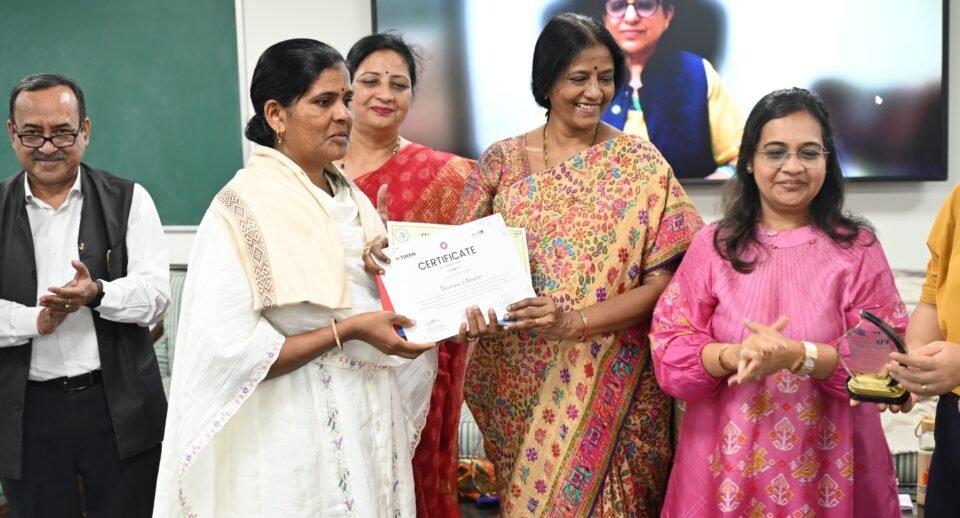
On Thursday, 25 rural women showed what that work can look like instead. Having learnt to fly agricultural drones at TiHAN, IIT Hyderabad, they walked up one by one to receive their certificates as the first graduates of FlySakhi – Drone Queens of Bharat.
Just ten days earlier, on 5 October, the cohort had begun with online theory classes. Then came hands-on flight training on the campus of one of India’s premier technology institutes.
Not just pilots, but proprietors
What sets FlySakhi apart is its ambition. The programme, run by the World Cooperation Economic Forum (WCOOPEF) and the Confederation of NGOs of Rural India (CNRI), with TiHAN–IIT Hyderabad as technology partner and Syngenta India as CSR partner, is not training women to work for someone else’s drone.
It is training them to own one.
Each graduate can now offer drone services — for a fee — to farmers, cooperatives and Farmer Producer Organisations (FPOs). Their certificates are designed to be bankable, so that a woman can walk into a bank and seek a loan for her own machine. The plan is to link graduates with cooperatives, Self-Help Groups and FPOs, so that both the asset and the income stay in the village.
Women do a large share of India’s farm work, but rarely own the land, machines or data that decide farm incomes. FlySakhi is a small but deliberate attempt to tilt that balance.
The woman behind the mission
For Smt. Shobha Yadav, Chairman of the CNRI Women Cell, the day was the latest chapter in a lifetime spent working for women’s empowerment. She has long argued that rural women must be owners and decision-makers, not just beneficiaries of schemes — and FlySakhi carries that conviction into the age of agri-tech.
It was Smt. Yadav who felicitated the guests and presented the FlySakhi journey to the gathering. Her message to the graduates was simple and direct.
“These women came as farmers and leave as entrepreneurs,” she said. “Our commitment now is to stand with them as they build their enterprises.”
An IIT that opened its doors
For many of the trainees, learning at an Institute of National Importance was itself a first. Organisers credited Prof. P. Rajalakshmi, Head of TiHAN — IIT Hyderabad’s Technology Innovation Hub on Autonomous Navigation — for making it happen.
Under her leadership, TiHAN made its facilities, expertise and flight-training infrastructure available to the cohort, holding the training to IIT standards while keeping it welcoming for first-time learners. In her address, she urged the women to see themselves as part of India’s autonomous-systems future. A leading woman technologist at the helm of a national innovation hub, she is, in many ways, the role model the programme hopes its graduates will become.
“Prof. Rajalakshmi and her team have shown how a great national institution can open its doors to the women of rural Bharat,” said Nirupam Mehrotra , Director BIRD, NABARD who has delivered Keynote address “Her leadership gave our sisters not just training, but the confidence of having learned at IIT Hyderabad.”
Backing that reached the last mile
The training was supported by Syngenta India under its Corporate Social Responsibility initiatives. Presiding over the session, Ms. Meenal Maheshwari, CFO, Syngenta India, kept the spotlight firmly on the graduates.
“Syngenta is proud to support these 25 women,” she said. “Their skill and confidence show what becomes possible when technology and opportunity reach the last mile.”
Dr. Sangeeta Dawar Mendiratta, who heads sustainability and corporate affairs at Syngenta India, linked FlySakhi to the company’s rural programmes such as I RISE, I CLEAN and WeCare, saying sustainable farming must go hand in hand with social progress. Ms. Nguyen Thi Mai Chi, Head of Syngenta’s Innovation Centre, and Division Manager Shri Chandrashekhar Ayyagaddi also spoke to the trainees.
A scientist’s word of advice
The Chief Guest, Dr. (Ms.) C. Tara Satyavathi, Director General, ICAR–National Institute of Plant Health Management and Director, ICAR–Indian Institute of Millets Research, brought the voice of science — and the example of one of India’s senior women agricultural scientists — to the hall.
Her advice to the new pilots was about responsibility. “Precise and safe use of crop inputs is central to plant health,” she said. “Trained women drone pilots can carry scientific practices to every field, and their role will only grow as drones take on monitoring and data services.”
Shri Vishwas Tripathi, Co-Chairman, CNRI, and Founder Chairman, Indo-Pacific Chambers of Commerce and Industry, turned the conversation to markets, linking the women’s new skills to business and industry opportunities and pledging support to connect graduates with demand. Dr. Nirupam Mehrotra, Director, BIRD, NABARD, delivered the keynote online, and Dr. Shankar Goenka of Wow Green also addressed the gathering.
More than a flying sprayer
Spraying may be the first job, but it is unlikely to be the last. The women were trained to see the drone as a flying platform for data and delivery.
The same machine, with the right payloads and permissions, can spot pest and nutrient stress early, sow seeds on degraded land, survey damaged fields for faster crop-insurance claims, map villages, and assess fields after floods or hailstorms. Each of those is a potential new income stream for a woman who already knows how to fly.
A nod to the woman farmer
The timing is no accident. The United Nations has declared 2026 the International Year of the Woman Farmer, urging countries to close the gaps women face in land, finance, technology and markets. FlySakhi takes on two of those at once: technology, through the training, and finance, through bankable certification.
The programme is also a flagship activity of CNRI’s Civil Society Resilience and National Awareness Mission (CSRNAM) 2026.
“A resilient nation is built in its villages,” said Shri Binod Anand. “Under CSRNAM, FlySakhi turns rural women into skilled entrepreneurs and confident leaders.”
Opening the session, WCOOPEF Chairman Shri Dileep Shanghani summed up the idea. “When a rural woman holds the controller of a drone, she holds the future of Indian agriculture,” he said. “Cooperation gives her the strength of the collective, and technology gives her the edge.”
What comes next
Before collecting their certificates, the trainees shared their experiences with the guests in an open interaction. The partners say more FlySakhi batches are planned, along with efforts to link graduates to credit, cooperatives, FPOs and steady demand for their services.
The bigger goal is a network of women-run, community-owned drone businesses across rural India. For 25 women in Hyderabad, it has already begun — and this time, the work does not have to be carried on their backs.
VORI NEWS Desk
