

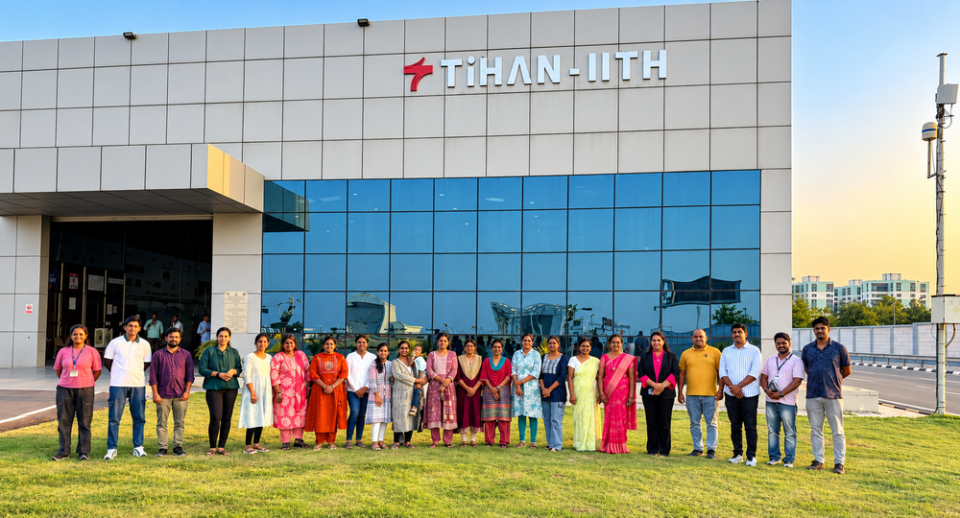
India has made technology a farmer’s entitlement. FlySakhi shows what happens when that promise reaches a rural woman’s hands
By Jitendra Sharma, Chairman, Confederation of NGOs of Rural India (CNRI) ·
For decades, the Indian farm has been a place where technology arrived late, if at all. The laboratory produced the science, the showroom stocked the machine and the ministry announced the scheme, yet the small farmer standing in her field rarely had the training, the finance or the market access to use any of it. The question was never whether rural India was willing to modernise. It was whether modernisation was willing to come to rural India on terms it could afford.
It was this gap that the Confederation of NGOs of Rural India (CNRI) sought to name in 2016, when it set out the principle of a Right to Technology for Farmers. The argument was simple: access to appropriate and affordable technology is not a favour bestowed on cultivators but a condition of agricultural justice. Farmers should be participants in progress, able to acquire the skill, build the enterprise and share in the value innovation creates, rather than remain its distant beneficiaries.
A decade on, that principle has found expression in national policy, and credit for this belongs squarely to the Government of India under the leadership of the Hon’ble Prime Minister. Liberalised drone rules opened Indian skies to agricultural operations within a clear training and certification framework. Kisan Drones signalled that frontier tools belong in the field. Namo Drone Didi placed drones in the hands of women’s Self-Help Groups. Soil Health Cards took science to the level of the individual farm, while SATAT, GOBARdhan and the ethanol-blending programme opened markets for farm biomass. CNRI records its deep gratitude to the Government for converting what was once an advocacy demand into a lived reality across rural India.
FlySakhi – Drone Queens of Bharat is CNRI’s attempt to show what that policy architecture can achieve when it meets a motivated rural woman. Between 5 and 15 October 2026, a first cohort of 25 women is training in agricultural drone technology, supported by Syngenta and in association with TiHAN, the Technology Innovation Hub on Autonomous Navigation at IIT Hyderabad. The curriculum goes beyond the joystick: mission planning, pre-flight safety checks, navigation, operational limits and the interpretation of what a drone sees from the air, reinforced through simulation and supervised flight where facilities allow.
The programme is deliberately candid about one point that is too often blurred. A course certificate is not a licence. Participants who wish to fly commercially must follow the remote-pilot training and DGCA certification pathway through an authorised Remote Pilot Training Organisation, and FlySakhi is designed to prepare them for that route, not to substitute for it. Credibility in an emerging profession is built on such distinctions.
The timing carries its own symbolism. The United Nations has declared 2026 the International Year of the Woman Farmer, and the gap it seeks to close is starkly visible in India. Women sow, weed, harvest, tend livestock and process the crop, yet their access to machines, credit and technical careers has lagged far behind their labour. A woman guiding a drone across a field is therefore more than an operator at work. She is a public correction of an old assumption about who is allowed to master advanced technology, and every girl watching from the field’s edge absorbs that lesson.
Training, however, is only the first test. The harder one is economic. A skilled operator needs equipment, maintenance, finance and, above all, steady customer demand. Here the cooperative model offers a practical answer. Shared-service arrangements through Farmer Producer Organisations, cooperatives and Self-Help Groups can aggregate demand, spread equipment costs and keep machines working beyond a single spraying season. Drones also have markets in crop monitoring, mapping, surveying and infrastructure inspection, though each requires its own sensors, skills and permissions. The ambition is a network of women-led rural technology enterprises, not a one-off batch of certificates.
The same logic of access must extend to the wider rural economy. Cattle dung and surplus crop residue can feed compressed biogas plants and advanced bioethanol units, turning waste into income and contributing to energy security. But the arithmetic must be honest. Feedstock availability, transport costs, competing uses for fodder, water needs and plant economics all have to be assessed before capital is committed, and farmers must participate on transparent terms rather than as mere suppliers of cheap raw material.
Nor can any of this come at the cost of the soil. Residues needed for organic matter and moisture retention should not be stripped away for energy. Soil testing, balanced nutrition, crop rotation and water conservation must accompany every new tool, and drone imagery is most valuable when combined with ground verification and sound agronomic advice. The real measure of agricultural technology is not only the next harvest, but the health of the land handed to the next generation.No single institution could have delivered FlySakhi alone, and its early success is a tribute to partnership.
CNRI is deeply grateful to Syngenta for backing an idea before it had a track record and for giving 25 women a chance to discover their own capabilities. We extend our sincere thanks to Professor Rajalakshmi of IIT Hyderabad and her colleagues at TiHAN, whose commitment brought world-class expertise in autonomous navigation within the reach of women from farming households. We owe special appreciation to WOW Green and its team in Hyderabad, led by Tanvi Rathore, whose dedication and on-the-ground effort turned a plan on paper into a programme that has truly succeeded. Above all, we salute the women of the first cohort, whose courage to learn something entirely new gives the initiative its meaning.
The road ahead calls for discipline as much as enthusiasm. CNRI intends to track every participant’s certification journey, connect trained women with farmers and cooperatives that need their services, test the viability of their enterprises, and publish what works so that it can be replicated across states. The first 25 are a beginning, not a destination.
India has accepted, through policy and investment, that technology must reach the farmer. FlySakhi demonstrates the next step: that it must also reach the woman farmer, and be placed firmly in her hands. The Right to Technology for Farmers is, in the end, the right to participate in progress. A drone takes flight with the push of a button. A far more consequential flight begins when a rural woman discovers what she is capable of achieving.
