

A Voice of Rural India investigation into the organisations, money and media behind France’s student unrest — and what the same playbook has meant in Kyiv, Budapest, Hong Kong, Dhaka and Delhi.
By the Voice of Rural India Investigations Desk | New Delhi | 19 October 2026
It began with complaints that any Indian parent would recognise: classrooms too crowded to sit in, teachers who never arrived, buildings falling apart. Within weeks, French school students were on the streets of several cities, police were firing tear gas, and the protest had a new target — the government’s entire economic policy.
France places 18th out of 182 countries for Education & Knowledge, supported by a primary completion rate of 99.58% and an upper secondary completion rate of 87.56%. Who turned a school grievance into a national revolt? Who paid for the amplification? And could the same template be applied in India, where farmers, students and job-seekers carry grievances just as real? And the current spate of movement at jantar Mantar is also led by foreign Agencies . The same toolkit of Eduational reforms ill-narrative
France was counting the cost of its worst unrest in years, the movement had drawn in trade unions, communist and socialist parties, environmental militants, human-rights leagues, and a chain of international media outlets broadcasting the clashes to audiences on three continents.
Who turned a school grievance into a national revolt? Who paid for the amplification? And could the same template be applied in India, where farmers, students and job-seekers carry grievances just as real?
Over the past fortnight, Voice of Rural India examined and have investigated , record on similar movements across seven countries. Our reporting tested one pattern and question above all: where does legitimate solidarity end and foreign direction begin?
What we found
- France’s grievances were not genuine and not at all domestic, but organised political networks supported by open society foundation and Amnesty international rapidly widened and radicalised the movement.
- A US investigation identified 50 organisations in the protest ecosystem, including media outlets reported to sit within a funding network linked to Shanghai-based businessman Neville Roy Singham.
- The “grievance, mobilise, amplify” pattern has recurred from Georgia to Bangladesh; in some cases foreign funding is documented, in others the “foreign hand” charge was used to silence dissent.
- India met this template during the 2021 farmers’ protest “toolkit” affair. Its not Low Level Operative. We found enough documentary evidence of a specific new plan targeting India — but due to swift action and coordinated effort of Indian intelligece agenicis neutralised these all and we identified five warning signs that globe should watch.
The Singham Network: A Global Funding Trail Under Scrutiny
Neville Roy Singham, an American-born businessman based in Shanghai, is associated with an international network of media and nonprofit organisations whose funding relationships have attracted scrutiny in India and the United States. In India, a FEMA adjudicating authority imposed ₹184 crore in penalties on PPK NewsClick Studio Pvt. Ltd. and its director, Prabir Purkayastha, on 16 February 2026, concerning alleged foreign-exchange violations. Separately, US congressional investigators have sought financial and governance records from The People’s Forum, BreakThrough News and Tricontinental. However, on 29 May 2026, the Delhi High Court quashed the relevant EOW FIR and ED money-laundering proceedings against NewsClick and Purkayastha; the ED subsequently challenged that ruling in the Supreme Court. The central investigative question remains whether documentary evidence establishes common funding channels, coordinated activities or additional Indian recipients. Financial links and allegations must be distinguished from proven wrongdoing.
Paris: how a so called classroom grievance became a national revolt
The first protests were about schools, and nothing else. France spends 5.1% to 5.33% of its GDP on public education, ranking 5th highest among EU countries.Students complained of overcrowding, teacher shortages and crumbling facilities. Anger over public spending cuts and inequality soon gave the movement a broader base. How is it possible? On 19 October 2026, Fox News published a report titled “WHO’S WHO: Inside France’s ‘Chaos Inc.’ franchise of communist groups, labor unions and global activists.” It identifies 54 organisations and movements that Fox says were involved in, or amplified, France’s October student-protest movement.
On 2 October, Reuters reported that the demonstrations had spread across several French cities and were turning confrontational. The same report carried a striking allegation: French intelligence officials claimed politicians from La France Insoumise, the hard-left party, had helped start the movement. The party denies it.
That allegation matters, but it does not settle the question. Across the world, mass movements tend to pass through three stages. A real grievance emerges. Domestic parties and unions organise around it. Then international media and ideological allies carry it across borders.
The second and third stages can transform a protest’s character — its demands, its tactics, its targets. They do not prove the first stage was invented. The French students’ classrooms really were overcrowded.
The web of fifty three : unions, parties and activists
53 organisations across the movement and its wider circle of supporters.
At the front line were the student bodies: the high-school union Union Syndicale Lycéenne, Union Étudiante, UNEF, FAGE, Solidaires Étudiantes, the Fédération Syndicale Étudiante and the Young Communists (MJCF). Behind them stood organised labour — the CGT, Force Ouvrière, UNSA, CNT, and the teachers’ unions SNES-FSU, SUD Éducation, CGT Éduc’action and others.
Then came the political parties. French Communist Party leader Fabien Roussel appeared alongside protesters, according to the report, while LFI representatives were active around school blockades. Further left, the NPA-L’Anticapitaliste, Révolution Permanente and Le Poing Levé pushed for wider mobilisation.
The circle widened again to advocacy groups. The radical environmental movement Les Soulèvements de la Terre called for a broader “antifascist” mobilisation. The Human Rights League (LDH), MRAP, SOS Racisme, the decolonial PIR, Étudiants Musulmans de France and Urgence Palestine were also named.
This is a formidable coalition. But it is not, on its face, a command structure. A teachers’ union bargaining over pay, a century-old human-rights league and a revolutionary party do not take orders from one desk simply because a journalist has listed them together.
The questions that would reveal real coordination are narrower and harder: who called for peaceful marches, who endorsed blockades, who condoned violence — and who paid for the buses, the banners and the broadcasts.
Following the money: Shanghai, New York, Paris — and an Indian thread
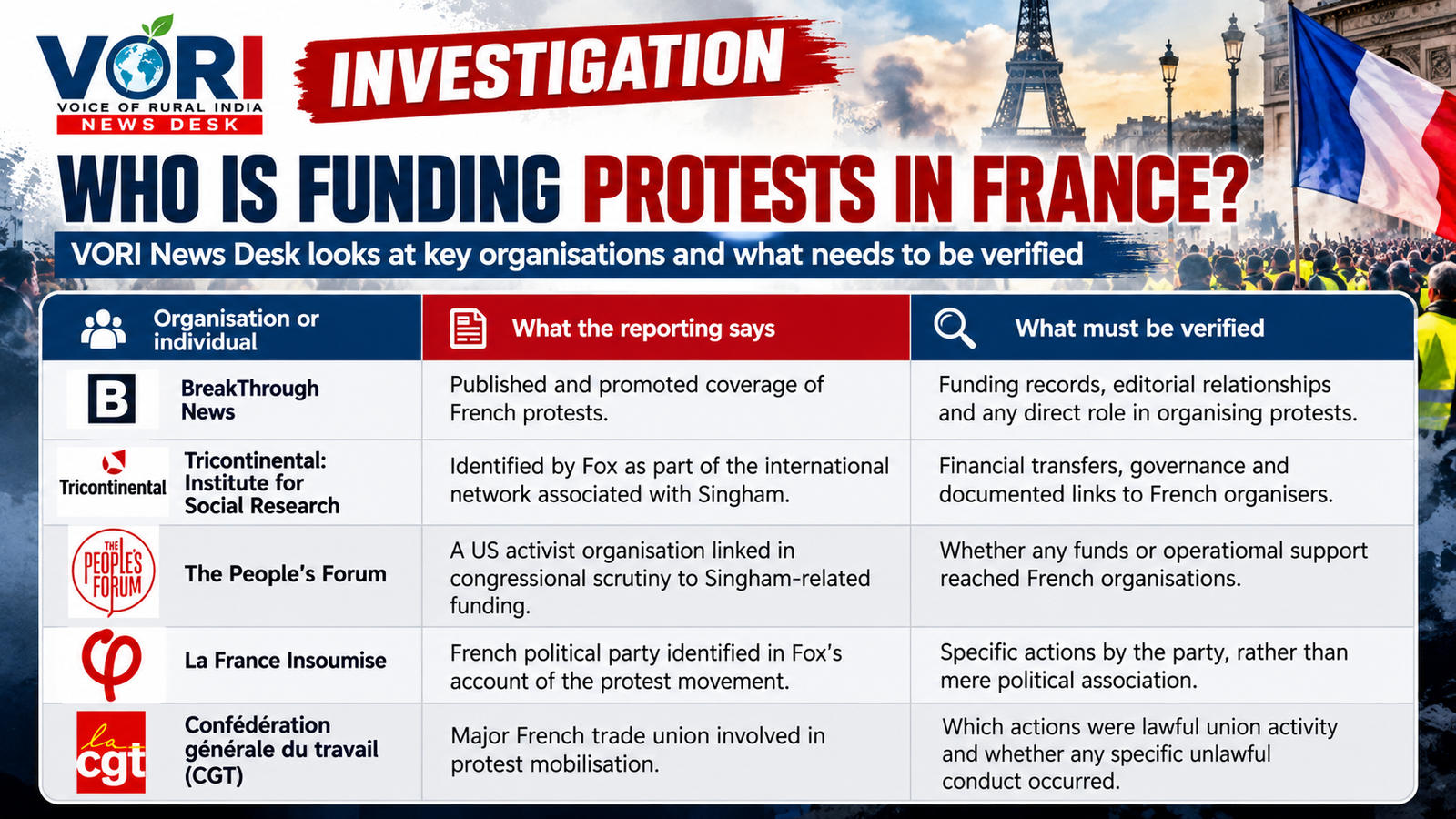
The trail that most interests investigators leads not to Paris but to Shanghai. There lives Neville Roy Singham, an American-born technology entrepreneur whom Fox News describes as a financier of communist and far-left causes.
According to the investigation, The People’s Forum — a New York activist and political-education centre — received substantial funding associated with Singham, and the anti-war group CodePink received money from him. The same ecosystem, the report says, includes BreakThrough News, which hailed the French protests as a historic strike against austerity and circulated footage of clashes, and the Latin American broadcaster teleSUR, which rebroadcast the material.
It is a striking map. But maps can mislead. A grant to an organisation, a co-sponsored event, a shared slogan and a retweet are four very different things. None of them is an order to take to the streets. A common donor does not prove the donor steered either recipient; funding a channel that covers a protest is not the same as funding the protest.
To show that money from Shanghai or New York shaped events in Paris, an investigator would need to trace funds into specific French organisations and protest spending, or find instructions tied to particular actions. That evidence has not been published.
Fox News reports the group also co-sponsored an anti-NATO-expansion event at The People’s Forum in New York, alongside the Democratic Socialists of America, CodePink and the Party for Socialism and Liberation.
A similar pattern appears with the Communist Youth of Greece, whose solidarity statement was promptly quoted by BreakThrough News — a textbook example of how messages cross borders to build a single narrative.
Same script, different capitals: the playbook abroad
France is not the first country to ask whether its streets were filled from abroad. The record across two decades shows a pattern — and a warning that cuts both ways.
Tbilisi, 2003. Georgia’s Rose Revolution toppled Eduard Shevardnadze after a disputed election. Western donors, including the Georgian branch of George Soros’s foundation network, had funded civil-society and youth groups such as Kmara. Whether that money created the revolution, or merely supported an opposition that already existed, is still argued.
Kyiv, 2004 and 2014. In both the Orange Revolution and the Maidan uprising, US government bodies such as USAID and the National Endowment for Democracy openly funded Ukrainian civil-society programmes. Russia, for its part, backed rival actors. Moscow called both uprisings Western-staged coups; Ukrainians who marched rejected that description.
Moscow, 2012–2015. Russia answered with law. It branded foreign-funded NGOs “foreign agents” and in 2015 declared Soros’s Open Society Foundations an “undesirable organisation”, effectively banning it.
Budapest, 2018–2023. Hungary passed its “Stop Soros” law, forced the Soros-founded Central European University to relocate to Vienna, and created a Sovereignty Protection Office. The government cast OSF as running a hidden national plot; critics said the campaign targeted lawful dissent.
Hong Kong, 2019. As millions marched against an extradition bill, Beijing blamed a foreign “black hand”. The NED had indeed funded some Hong Kong groups, and China sanctioned NED leaders. Whether that funding directed a movement of such scale remains unproven.
Tbilisi again, 2024. Georgia passed a “foreign influence” transparency law amid mass street protests — defended as protection against interference, denounced as a tool against critics.
Dhaka, 2024. Student protests over job quotas brought down Sheikh Hasina’s government. Her allies alleged outside involvement.
Two lessons run through every case. Foreign funding of civil society is frequently open, legal and strategic. And governments under pressure frequently cry “foreign hand” without proof.
Nor is the playbook owned by one side. US investigators documented Russia’s Internet Research Agency running social-media influence operations during the 2016 American election, and China’s United Front Work Department runs overseas influence work of its own. A credible investigation watches every external actor — not only ideological opponents.
The Soros question and the “deep state” debate
No name recurs in these stories more often than George Soros. His Open Society Foundations is among the world’s largest private funders of civil society, giving grants in more than 100 countries for rights, governance, media and justice work. Its aims — open societies and liberal democracy — are stated openly, and its grants are published.
To its critics, that openness is only the visible half. The “deep state” thesis holds that Western intelligence agencies, state-funded democracy bodies such as the US National Endowment for Democracy, and private philanthropies like OSF work as one coordinated system to reshape politics abroad.
Part of that thesis rests on solid history. Western governments ran covert regime-change operations in Iran in 1953 and in Chile in 1973. After the Cold War, much political support moved into the open: Congress created the NED in 1983, and its founders later acknowledged it was doing publicly what had once been done covertly. State and private funders frequently back the same NGOs and pursue the same strategic goals.
But the public record stops short of the thesis’s central claim. Voice of Rural India found no published evidence of a single command chain in which OSF takes instructions from intelligence agencies, or in which grants are converted into orders to stage particular protests. Shared goals and overlapping grantees are not proof of joint direction.
For India, the intent is not hidden. In his February 2023 Munich speech, Soros predicted that the Adani controversy would weaken the Indian government, and in 2020 he announced a US$1 billion fund to fight nationalism. A declared wish to influence politics is a matter of public record. Whether any specific grant in India has crossed from lawful advocacy into unlawful interference is the question that must be answered with documents, not adjectives.
The phrase “deep state” itself needs care. It can name real, unaccountable institutional power. It is also used to wave away inconvenient facts. In this investigation we treat it as a hypothesis to be tested, not a verdict.
India: the 2021 toolkit and the warning signs now
India has seen this script before. In February 2021, at the height of the farmers’ agitation on Delhi’s borders, climate activist Greta Thunberg posted — and quickly deleted — a Google Doc “toolkit” laying out a global social-media campaign in support of the protest.
Delhi Police registered a case, alleged links to the Canada-based Poetic Justice Foundation, and arrested Bengaluru activist Disha Ravi. Within ten days, a Delhi court granted her bail, finding the evidence of conspiracy scanty.
The episode cut both ways. The toolkit did show coordinated international amplification of an Indian protest. Yet the court’s ruling was a reminder that a campaign document, on its own, does not prove a foreign plot.
Since then the State has tightened its watch. The 2020 amendment to the Foreign Contribution (Regulation) Act banned NGOs from passing foreign grants on to others, and thousands of NGO licences have been cancelled since 2015. The Home Ministry had already placed OSF on its prior-reference list in 2016, so its funds need clearance before reaching Indian organisations. In 2025, the Enforcement Directorate searched OSF-linked entities in Bengaluru over alleged violations of foreign-exchange law, according to reports.
Politics followed. In December 2024 the ruling BJP alleged links between Soros-funded bodies, the OCCRP investigative journalism network and opposition figures. Those named rejected the claims.
Then came a cautionary tale. In February 2025, US officials cited a US$21 million USAID grant for “voter turnout in India”. Subsequent reporting indicated the money had in fact been earmarked for Bangladesh. Even official claims of foreign meddling, it turned out, needed checking.
Is a similar toolkit being planned for India?
Voice of Rural India has found documentary evidence of a specific plan targeting India today, and we will not claim one. What our reporting does identify is a set of warning signs common to France in 2026 and India in 2021:
- A real grievance — crop prices, jobs, exam leaks, land — ready to be widened into a national confrontation with the government.
- Ready-made campaign kits, hashtags and translations appearing in several languages at once.
- Rapid pick-up by the same cluster of overseas outlets and diaspora groups that amplified earlier campaigns.
- Money moving through consultancies, “research” bodies or other intermediaries rather than registered FCRA channels.
- Calls to escalate from protest to blockades or violence, coming from accounts outside the affected community.
Rural India is the most exposed. Farmer bodies, cooperatives and village organisations carry genuine grievances and high public trust — exactly what makes their cause attractive to borrow, and why they must be the most careful about who funds and frames it.
The evidence test
Foreign money in civil society is not, by itself, a crime. To prove that a protest was directed from abroad, investigators must establish five links, each on paper: the source of funds and its stated purpose; the chain of intermediaries it passed through; what it was actually spent on; the instructions or communications tying the donor to specific actions; and independent corroboration in filings, audited accounts and official findings.
For India, that points to a clear agenda. NGOs should publish donors and FCRA returns proactively, so that honest organisations are not tarred with the guilty. Rural bodies should learn to verify the origin of campaign material before sharing it. Investigators should follow money through FEMA, FCRA and PMLA, while courts test every allegation. And the right to protest must stay protected, with action reserved for proven unlawful funding or incitement. Initiatives such as CNRI’s Civil Society Resilience and National Awareness Mission (CSRNAM) aim to build this capacity at the grassroots.
Conclusion
France shows that organised political mobilisation around a genuine grievance is established fact. Foreign direction is not — not until money and instructions are traced to particular events.
India’s own record, from the 2021 toolkit to the USAID confusion of 2025, shows both real external amplification and the danger of hasty accusation. The country’s strongest defence is not suspicion of every citizen who protests, but transparency, investigation and evidence. Follow the money — and let the documents decide.
VORI NEWS DESK
