

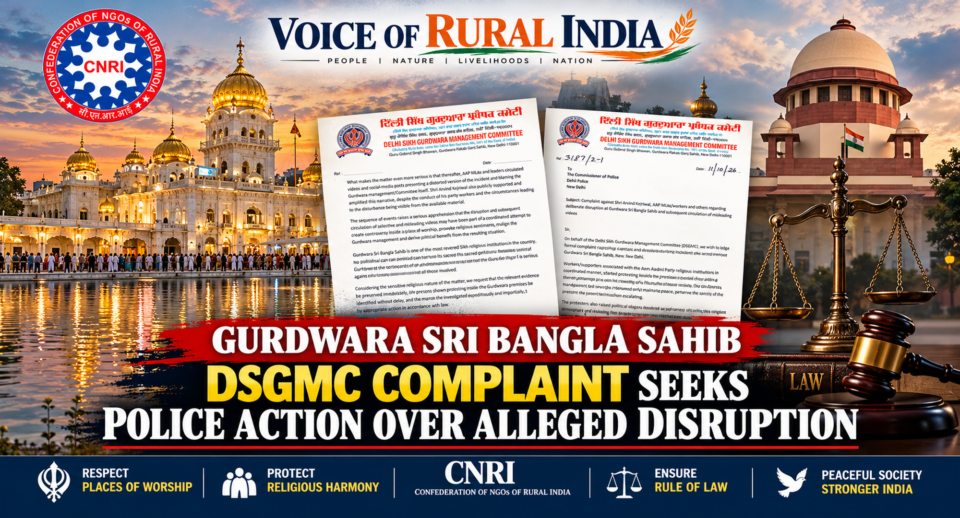
CNRI calls on the Union Government to examine CJP’s activities under the UAPA, and appeals to the Chief Justice of India to take suo motu cognisance
By Binod Anand
Secretary General, Confederation of NGOs of Rural India (CNRI)
The unity of India rests on more than its frontiers. It rests on public trust, on reverence for places of worship, and on the constitutional promise that no person or organisation stands above the law. When a revered shrine is pulled into a political confrontation, and claims about it spread faster than they can be verified, the State and the courts have a duty to establish the truth.
The controversy surrounding Gurdwara Sri Bangla Sahib, New Delhi, is such a moment.
What has been reported
According to a Hindustan Times report of 11 October 2026, CJP co-convenor Saurav Das alleged that Delhi Police personnel entered Bangla Sahib wearing shoes and carrying weapons. He reportedly appealed to Sikh citizens to join the fight against the Government.
Delhi Police has disputed this. It states that the footage in circulation shows personnel in a common passage leading to the shoe-removal area, not inside the sanctum. Other accounts of the incident also differ.
These are serious and opposing claims. Both cannot be true. Each has the potential to inflame religious feeling across the country.
Why this matters beyond Delhi
Gurdwara Bangla Sahib is a place of deep spiritual significance to the Sikh community and to countless Indians of every faith. To say falsely that a sanctum has been desecrated is to strike at the most sensitive nerve of a community. To call a religious community to arms against the State on that basis takes the danger further. Such an appeal invites confrontation between a community and the State, and India has paid a heavy price for that in the past.
The right to criticise the Government and to protest peacefully is guaranteed by Article 19 of the Constitution, and CNRI affirms it without reservation. That right does not extend to inventing desecration or exploiting the faith of a community as an instrument of political mobilisation. Equally, if any police personnel did violate the sanctity of the shrine, that too is a grave wrong demanding accountability.
The question is therefore one of truth, and only an impartial, evidence-based inquiry can answer it.
The applicable law
The Bharatiya Nyaya Sanhita, 2023 provides a complete framework. Each provision must be applied only where the evidence meets its requirements.
- Section 196 covers promoting enmity between groups on grounds of religion, or acts prejudicial to the maintenance of harmony.
- Section 197 covers imputations and assertions prejudicial to national integration.
- Section 299 covers deliberate and malicious acts intended to outrage religious feelings.
- Section 300 covers voluntarily causing disturbance to a religious assembly.
- Section 353 covers statements, rumours or reports made with intent, or likely, to cause fear, alarm, or offence against public tranquillity.
- Section 152 covers acts endangering the sovereignty, unity and integrity of India. It applies only where the evidence shows conduct of the kind the section describes.
Where an organisation, as distinct from an individual, is alleged to be behind such conduct, the Unlawful Activities (Prevention) Act, 1967 provides two separate mechanisms:
- Section 3 lets the Central Government declare an association unlawful for activities that question or disrupt the sovereignty and territorial integrity of India. Such a declaration must be confirmed by a Tribunal presided over by a High Court Judge.
- Section 35 empowers the Central Government to designate an organisation as a terrorist organisation where it believes the organisation commits, participates in, prepares for, promotes or encourages terrorism, or is otherwise involved in it.
These are the gravest powers the law confers on the executive. The safeguard in using them lies in the evidence. The Supreme Court in Balwant Singh v. State of Punjab (1995) cautioned against criminalising mere words that produce no public disorder. The same Court in Shaheen Abdullah v. Union of India (2022, extended 2023) directed police to register cases suo motu against hate speech, irrespective of the speaker’s religion or affiliation. Both principles must guide the response here.
CNRI’s demand to the Union Government
CNRI calls upon the Ministry of Home Affairs, the Government of NCT of Delhi and the Commissioner of Police, Delhi to:
- Preserve all evidence immediately: the original and complete recordings, CCTV footage from the gurdwara premises, digital metadata, and the social-media posts and communications connected with the incident.
- Verify the allegations attributed to CJP’s co-convenor against the complete footage, the account of the gurdwara management, and independent eyewitnesses.
- Identify who created, edited or circulated any misleading footage, and determine whether this was done knowingly and with intent or likelihood of provoking religious hostility.
- Register cases under the BNS where the evidence discloses an offence, consistent with the Supreme Court’s directions in Shaheen Abdullah.
- Examine, through the Ministry of Home Affairs and on the material gathered, whether CJP’s activities attract Section 3 or Section 35 of the UAPA. If the statutory threshold is met, the Government should act without hesitation or political favour.
- Inquire equally into the conduct of police personnel, and act against any officer found to have violated the sanctity of the shrine.
CNRI’s appeal to the Hon’ble Chief Justice of India
CNRI respectfully appeals to the Hon’ble Chief Justice of India to take suo motu cognisance of this matter under Article 32 of the Constitution. The allegations concern the sanctity of a place of worship, communal harmony in the National Capital, and the rights of citizens of every faith under Articles 14, 21 and 25. CNRI prays that the Hon’ble Court may be pleased to:
- direct the preservation of all evidence connected with the incident;
- direct a time-bound investigation, monitored by the Court or carried out by an independent agency, into both the allegations against Delhi Police and the allegations of fabricated or misleading content;
- direct the competent authorities to ensure compliance with Shaheen Abdullah in relation to any speech that promotes enmity between communities or the State; and
- issue such guidelines as the Court deems fit against circulating unverified claims of desecration of places of worship during public agitations.
The principle that must prevail
National security is not served by accusation alone, and religious harmony is not served by silence. If the evidence establishes that a sacred shrine was deliberately used to spread falsehood and mobilise a community against the State, the full force of the law, including the UAPA, must follow. If it establishes misconduct by police personnel, that must be punished with equal firmness.
No organisation is above the law. No faith may be turned into a weapon through falsehood. And no one, citizen or State, may be condemned except on evidence and through due process. That is how India’s unity is defended.
— Binod Anand
Secretary General, Confederation of NGOs of Rural India (CNRI)
