

Binod Anand is Secretary General of CNRI
10 min read
The colonial flag has gone. The colonial mindset must go with it.Foreign money is not automatically foreign influence, and a foreign-funded NGO is certainly not automatically a threat to India. India has thousands of organisations doing invaluable work in healthcare, education, rural development, disaster relief, scientific research, livelihoods, environmental protection and humanitarian assistance. Their contribution deserves respect and recognition. But there is another truth that no responsible democracy can afford to ignore: when money crosses borders, influence can cross borders with it. Globalisation has made the movement of people, ideas, technology and financial resources across national boundaries faster and more complex, and governments around the world have consequently become increasingly concerned about transparency, foreign influence and the protection of democratic institutions. FCRA is intended to permit legitimate international cooperation while ensuring that foreign contributions are received, utilised and accounted for according to Indian law.
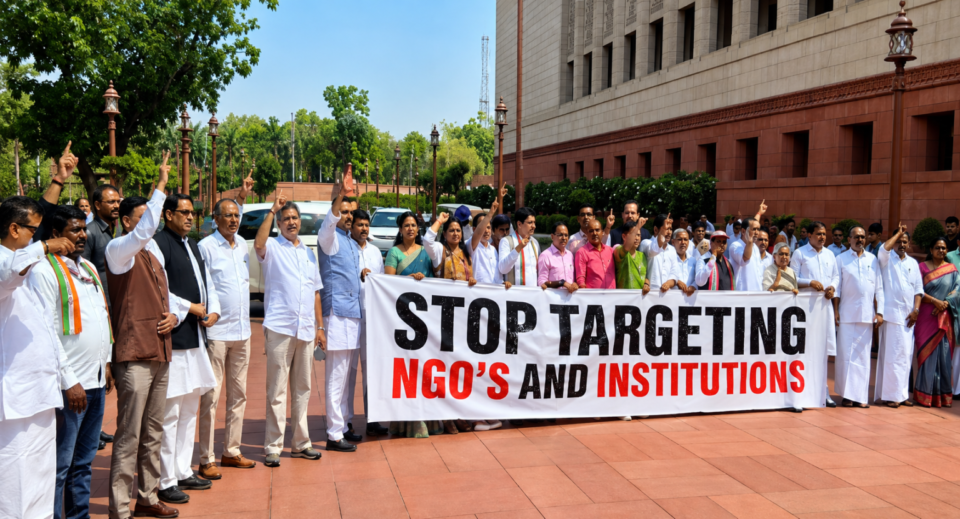
The Confederation of NGOs of Rural India (CNRI) strongly condemns the attempts by certain anti-development organisations, vested interests and commentators to portray the Foreign Contribution (Regulation) Amendment Bill, 2026, as an attack on NGOs or civil society. Such a narrative is not only misplaced but deeply unfair to India’s enormous voluntary sector, which has contributed to nation-building at the grassroots for decades. CNRI speaks from the experience of a national civil-society network which publicly describes itself as having 7,000 NGO members, 29 State chapters and 634 district chapters, and as the world’s largest confederation of NGOs. CNRI also holds Special Consultative Status with the United Nations Economic and Social Council (UN ECOSOC), a formal consultative relationship that enables qualified NGOs to participate in the work of the UN system. It is precisely because CNRI represents a substantial section of India’s voluntary sector and participates in international civil-society processes that it believes the NGO community must distinguish between legitimate criticism of legislation and an irresponsible campaign to undermine every attempt at transparency and national-security regulation. The honest NGO has nothing to fear from sunlight.
The scale of foreign contribution makes this far too important to dismiss as mere bureaucratic paperwork. The Government states that in 2024–25 approximately 16,200 associations received about ₹22,963 crore in foreign contribution. It also notes that nearly 20,000 registrations have been cancelled and around 15,000 have been deemed ceased over the last decade, leaving a practical question about the custody and management of foreign-funded money and assets after an organisation’s FCRA status ends. The proposed 2026 Bill seeks to address precisely this gap by creating a more detailed framework for provisional and permanent vesting, management, restoration and disposal of such assets. The question before India is therefore not whether NGOs should exist, nor whether international philanthropy should be welcomed. The question is much simpler: when foreign money enters India, should a sovereign country know where it came from, why it came, how it was used and what happens to assets created from it? The answer should surely be yes.
Yet instead of engaging with that question, some critics have chosen to attack the intention of the Government. Every attempt to strengthen financial transparency is portrayed as anti-NGO; every national-security concern is presented as an assault on civil society; every regulatory provision is interpreted as evidence of some hidden political agenda. This approach does not strengthen democratic debate—it weakens it. A Bill should be challenged clause by clause. If a provision is unconstitutional, identify it. If a compliance requirement is excessive, demonstrate the burden. If a safeguard is inadequate, propose a better one. If due process requires strengthening, demand it. But attributing sinister motives to the Government is not a substitute for examining the legislation. Democracy gives citizens the right to question the Government; it does not give any institution the right to demand exemption from scrutiny.
The international experience makes India’s position even more reasonable. The United States has operated the Foreign Agents Registration Act since 1938; Australia has its Foreign Influence Transparency Scheme; the United Kingdom has introduced its Foreign Influence Registration Scheme; and other major democracies have similarly strengthened transparency around foreign influence. The PIB’s comparative analysis describes this as part of a wider global movement toward greater transparency in foreign funding and foreign-directed activity. These countries have not abolished civil society. They have not declared NGOs enemies of democracy. They have simply recognised a principle that India should also recognise: an open democracy does not have to be a naïve democracy. International cooperation and national security are not opposites; transparency is what allows them to coexist.
Norad provides another instructive example. Norway’s development agency has openly allocated NOK 540 million for 2026–28 to six civil-society agreements in developing countries, describing the objective as strengthening civil society and promoting development and social change. Norad publishes its programmes and funding information openly. The significance is not that this proves some secret foreign conspiracy—it does not. The significance is precisely that a foreign government openly recognises civil society as a channel through which development, participation and social change can be advanced. If donor governments themselves understand that civil society can contribute to social and institutional change, India is perfectly justified in understanding the financial relationships through which such influence may operate within India.
There is no justification for calling every foreign grant part of a secret conspiracy without documentary evidence. But it would be equally naïve to pretend that money cannot influence institutions, research priorities, public narratives or policy debates. A foreign-funded organisation working on agriculture, climate, governance, education, livelihoods, human rights or public policy may be doing completely legitimate work. That is not the issue. The legitimate question is: who provided the money, what was its stated purpose, whether any conditions were attached, and whether the recipient retained independent decision-making? That is not a conspiracy theory. That is transparency.
The connection becomes clearer when we consider what can be called narrative economics. A grant can fund research; research can produce a report; a report can shape public debate; public debate can generate political pressure; political pressure can influence policy; policy can influence regulation; and regulation can affect agriculture, land, energy, infrastructure, investment, technology and employment. No secret conspiracy is necessary for this chain to exist. Ideas have economic consequences, and money can influence which ideas receive resources, visibility and institutional support. That is why the question of foreign funding cannot always be reduced to the immediate charitable activity for which a grant was received. The wider institutional ecosystem also matters.
For India, this question is inseparable from sovereignty. Sovereignty today is not limited to territory and political independence. It also includes economic sovereignty, technological sovereignty, institutional sovereignty, intellectual sovereignty and narrative sovereignty. A country may possess political independence while becoming dependent on external institutions for knowledge, external funding for development priorities, external frameworks for policy thinking and external validation for understanding its own society. A truly developed nation must possess the confidence to cooperate with the world without becoming dependent upon the world for the definition of its own national priorities.
This brings the debate directly to the unfinished task of decolonisation. Colonialism did not operate only through armies and territorial occupation. It also operated through control over trade, resources, institutions, knowledge and narratives. Political colonialism ended in 1947, but its intellectual, economic and institutional shadows can survive long after the colonial flag has disappeared. Decolonisation therefore cannot mean simply removing colonial symbols. It must mean eliminating colonialism in all its contemporary forms and manifestations—economic, intellectual, institutional, cultural and narrative.
Decolonisation does not mean rejecting the world; it means refusing to remain subordinate to it. It does not mean rejecting foreign knowledge; it means having the confidence to evaluate that knowledge on India’s own terms. It does not mean rejecting international philanthropy; it means ensuring that philanthropy does not quietly become a substitute for Indian public policy. It does not mean closing India’s doors; it means ensuring that those who enter through them recognise India as a sovereign partner rather than a development laboratory. FCRA 2026 can therefore be viewed not simply as a financial regulation, but as one component of India’s broader movement from political independence toward financial, institutional, intellectual and narrative self-confidence.
This is particularly important for the vision of Viksit Bharat 2047. A developed India cannot be measured only by GDP, highways, airports, digital infrastructure or industrial output. A genuinely developed India must also have strong institutions, public trust, social cohesion, policy autonomy and the ability to determine its own development priorities. Development without sovereignty can become dependency. Globalisation without transparency can become vulnerability. Civil society without accountability can lose public trust. Political independence without intellectual confidence leaves the work of decolonisation unfinished.
It is in this context that the provisions of FCRA 2026 should be understood. The existing FCRA framework does not prohibit legitimate foreign contribution. It creates conditions for receiving and using it. Foreign contributions must enter through a designated and verifiable banking channel; organisations must disclose receipts and utilisation; annual audited returns are required; and administrative expenditure is capped at 20 percent. The 2026 Rules move toward more precise activity- and State/UT-specific registration, project- and activity-wise utilisation reporting and identification of the ultimate foreign donor even where funds pass through intermediaries. These are not measures designed to eliminate civil society. They are measures designed to make foreign-funded civil society more transparent, credible and accountable.
The proposed Bill also contains provisions that are often conveniently omitted from the criticism. It creates a more detailed mechanism for dealing with foreign-funded assets when registration ends; it provides for provisional vesting and restoration; it creates a route for revision and judicial appeal; it protects the religious character of places of worship; it proposes coordinated investigation rather than fragmented parallel proceedings; and it actually reduces the maximum imprisonment for specified violations from five years to one year. A serious parliamentary debate should examine these provisions honestly. It should identify weaknesses where they exist and suggest improvements. What it should not do is turn every regulatory safeguard into evidence of an alleged war against civil society.
CNRI therefore strongly condemns attempts by anti-development organisations, vested interests and campaigners to manufacture an artificial confrontation between the Government and India’s voluntary sector. The NGO sector is not the enemy of development; it is one of India’s development partners. But partnership does not mean exemption from accountability. Those who claim to defend NGOs by demanding immunity from financial scrutiny are, perhaps unintentionally, weakening the credibility of the entire sector. Those who portray every national-security measure as an assault on democracy risk making the public suspicious of the very institutions they claim to protect. And those who respond to the simple question—“Who is funding this organisation, for what purpose and where is the money going?”—by accusing the questioner of being anti-democratic should perhaps reconsider what democracy actually means.
CNRI’s position is not that NGOs should remain silent. Quite the opposite. A strong civil society must be able to question government, scrutinise legislation and propose improvements. NGOs should demand due process, proportionality, transparent valuation of assets, protection of legitimate domestic-funded property, protection of beneficiaries and meaningful judicial remedies. They should submit evidence to Parliament and argue their case fearlessly. That is responsible dissent. That is democratic participation. That is precisely what a mature civil society should do. What CNRI rejects is the politics of blanket condemnation, where the Government’s intention is attacked before the substance of the Bill is seriously examined.
The honest NGO has nothing to fear from transparency. It should be able to say: this is my donor; this is what I received; this is why I received it; this is where I spent it; these are my beneficiaries; these are my outcomes. Such an organisation becomes stronger when the rules are clearer. Transparency protects legitimate organisations from suspicion; accountability protects the sector from the misconduct of a few; and financial traceability protects beneficiaries whose welfare should always remain at the centre of development work. The greatest threat to genuine civil society is not responsible regulation. It is the loss of public trust.
India should therefore reject both extremes. It should reject the paranoid belief that every foreign-funded NGO is part of a conspiracy. But it should equally reject the naïve belief that every foreign-funded activity is automatically beyond scrutiny because it carries the label of charity, development or civil society. Neither paranoia nor naivety is a national-security policy. Transparency is.
The real debate over FCRA 2026 is not Government versus NGOs. It is not national security versus civil society. It is not India versus the world. It is a choice between transparent cooperation and opaque influence, partnership and dependency, sovereignty and vulnerability. India should remain open to international philanthropy, knowledge, technology, humanitarian assistance and global partnerships. But openness must never mean surrendering strategic visibility. India can be globally connected without becoming globally dependent.
CNRI therefore calls upon responsible NGOs, voluntary organisations, development institutions, researchers and civil-society leaders to participate constructively in the parliamentary process, examine the Bill clause by clause, submit evidence, demand safeguards where necessary and support the fundamental principle that foreign financial contribution must remain transparent, traceable and consistent with India’s national interest. This is not an anti-NGO position. It is a pro-NGO, pro-development, pro-transparency and pro-sovereignty position.
India has already achieved political independence. The next chapter is to deepen financial independence, intellectual independence, institutional independence and narrative independence. That is the unfinished work of decolonisation. India should be happy to receive help, happy to cooperate and happy to learn from the world—but it must possess the confidence to decide its own future.
The world may contribute to India’s journey. But the destination—and the road to it—must belong to India.
And perhaps the simplest answer to the critics is also the most powerful: if the money is clean, the purpose is legitimate, the organisation is independent, the beneficiaries are genuine and the accounts are transparent, what exactly is there to fear from sunlight?
FCRA 2026 is not India closing its doors to the world. It is India opening those doors with its eyes open.
Let the money come. Let the ideas come. Let the partnerships come. Let the world work with India. But let every rupee be traceable, every relationship visible, every institution accountable and India’s sovereignty non-negotiable.
India does not reject the world. India simply refuses to surrender itself while engaging with it.
