

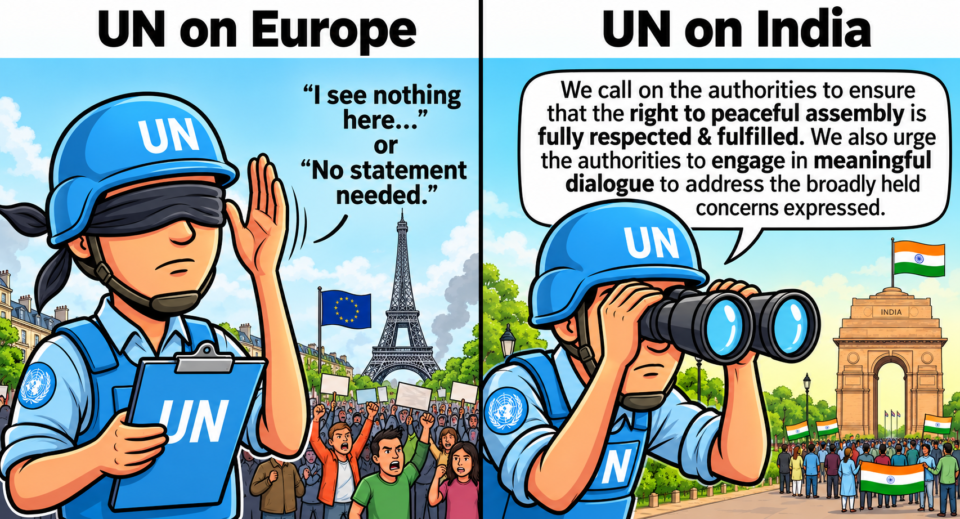
Human-rights scrutiny of any State is legitimate. Scrutiny that outpaces evidence, bypasses domestic remedies and is applied unevenly is not. The Office’s two statements on India in October 2026 fail that test.
By Binod Anand
On October 10, 2026, the Office of the United Nations High Commissioner for Human Rights (OHCHR) issued a comment on the same day regarding the detention of demonstrators in New Delhi, calling for the “immediate and unconditional” release of those it described as being arbitrarily detained. On October 20, the Office published a joint statement by more than twenty Special Procedures mandate-holders who concluded that India’s measures violate its core international legal obligations.
The question these statements raise is not whether India is subject to international human-rights scrutiny. As every State party to the International Covenant on Civil and Political Rights (ICCPR) is, India is. The question is whether that scrutiny was exercised within the legal limits of the mandate: respect for sovereign equality and domestic jurisdiction, the primacy of domestic remedies, evidentiary rigour, and the principles of objectivity and non-selectivity that the General Assembly itself has made binding on the Office.
This article argues that it was not. When international bodies pronounce on the legality of a sovereign State’s conduct before its own institutions have done so, on unverified information, and in terms they do not use for comparable or graver conduct elsewhere, they do not strengthen human rights. They erode the consent of nations on which the entire international human-rights system rests.
Accordingly, the Confederation of NGOs of Rural India (CNRI), an organisation in Special Consultative Status with the UN Economic and Social Council, has formally represented to the High Commissioner for reconsideration and withdrawal of the October 10 statement.
The normative framework
The starting point is the Charter of the United Nations. Article 2(1) establishes the Organization on the basis of the sovereign equality of its Members. Article 2(7) states that nothing in the Charter authorises the United Nations to intervene in matters essentially within the domestic jurisdiction of any State. The Friendly Relations Declaration (General Assembly resolution 2625 (XXV)) restates the duty of non-intervention as a principle of general international law.
No serious scholar today interprets Article 2(7) as placing human rights outside the scope of international concern. The Vienna Declaration of 1993 affirms that the promotion and protection of human rights is a legitimate concern of the international community.
However, the same Declaration, in paragraph 32, requires that human-rights questions be addressed with universality, objectivity and non-selectivity. And General Assembly resolution 48/141, which established the position of High Commissioner, explicitly requires the High Commissioner to act with respect for the sovereignty, territorial integrity and domestic jurisdiction of States. International concern and sovereign respect are not mutually exclusive; the mandate requires both simultaneously.
Three additional principles complete the framework.
First, subsidiarity: international protection is secondary to national protection, which is why the rule of exhaustion of domestic remedies is present in all human-rights treaty systems.
Second, legality of restriction: Article 21 of the ICCPR allows for restrictions on assembly necessary for public order, public safety, national security and the rights of others, and the Human Rights Committee, in General Comment No. 37, acknowledges that States may implement notification regimes for assemblies.Third, procedural fairness: the Code of Conduct for Special Procedures (Human Rights Council resolution 5/2) requires mandate-holders to rely on objective and reliable information and to consider the State’s perspective — the principle of audi alteram partem.
The organisers provided three days’ notice of a demonstration at Jantar Mantar; Delhi Police guidelines require ten. Permission was denied based on public safety concerns, and prohibitory orders under Section 163 of the Bharatiya Nagarik Suraksha Sanhita were in effect throughout the district that contains Parliament and the seat of government. Those who refused to disperse were detained and subsequently released.
The measures were not taken in isolation. According to Delhi Police, stone-pelting near the protest site injured senior officers on July 22 and 25, 2026, and by late July more than 200 police personnel and over 65 protesters had been injured during the agitation (ThePrint/PTI). The organisers dispute responsibility, and investigations are ongoing. Public comments describing the agitation’s objective as “regime change”, and references by participants to the 2024 overthrow of the government of Bangladesh, were also part of the record; the movement’s founder has stated that its demand is limited to the removal of the Chief Election Commissioner. These are exactly the considerations of public order and national security that Article 21 of the ICCPR allows a State to consider. Neither statement from Geneva considered them.
Selectivity in practice
The principle of non-selectivity is evaluated not by what an institution states, but by whether it states the same thing about similar cases. The record does not support that evaluation.
In Pakistan-occupied Jammu and Kashmir, in June and July 2026, dozens of people, many of whom were protesters, were reportedly killed and the territory’s internet was shut down. The High Commissioner called for calm and requested investigations; as India stated before the Third Committee on October 14, no follow-up report has been released (ThePrint/PTI). Fatalities resulted in a call for calm. Detentions without fatalities in New Delhi resulted in a demand for unconditional release. That is an inversion of proportionality, not an application of it.
The practice of Western European States supports the pattern. In The Hague in September 2023, Dutch police detained approximately 2,400 protesters in a single day, including minors, using water cannons (NL Times). In November 2024, Amsterdam declared a city-wide emergency ban on demonstrations and removed 340 people from a banned assembly — a measure very similar to a Section 163 order (NBC News/Reuters). Norway arrested and fined protesters blocking its oil ministry in 2021 and removed Sámi Indigenous protesters from government ministries in 2023. France deployed 80,000 police and gendarmes on a single day in September 2025, resulting in nearly 300 arrests within hours. Bavaria has detained climate activists in preventive custody for up to 30 days without charges. In Togo in June 2025, at least seven people died when protests were suppressed.
A review of the Office’s press releases and spokesperson comments reveals no similar same-day call for the unconditional release of those detained in any of these situations. In each case the Office, correctly, deferred the legality of the measures to the domestic legal system. The principle of sovereign equality requires that India’s legal system receive the same deference. It is relevant that the Netherlands co-hosted the High Commissioner’s Global Alliance for Human Rights event at UN Headquarters on September 23, 2026, which this author attended. There is nothing inappropriate about that; the point is that a standard applied to one State and not to its co-sponsors cannot be considered universal.
The inversion of priority: established violations and untested allegations
While selectivity among protest situations is concerning, the treatment of judicially established violations is even more concerning.
In Strand Lobben and Others v. Norway (2019), the Grand Chamber of the European Court of Human Rights determined that Norway’s child welfare service had violated the right to respect for family life through forced adoption. The same service in 2011 removed two Indian children, aged three and one, from their parents in Stavanger, an event that required the Government of India to send a special envoy before the children were returned. Norway’s own authorities later acknowledged that its welfare agency had misapplied European law for years, with at least 48 people wrongly convicted of benefit fraud and 36 of them imprisoned.
In the Netherlands, up to 26,000 parents were wrongly accused of childcare-benefit fraud, and the tax authority admitted that at least 11,000 were targeted based on ethnic origin or dual nationality; the government resigned in 2021. In Basu v. Germany (2022), the European Court determined that Germany had failed to investigate racial profiling by its police. In J.M.B. and Others v. France (2020), it determined French prison conditions to be inhumane and degrading and the issue to be structural.
These matters involve the most fundamental guarantees of the ICCPR: liberty, fair trial, non-discrimination and freedom from degrading treatment. Each was, appropriately, left to courts, parliaments and treaty processes. None generated a same-day pronouncement of the type directed at India, where no court has found any violation at all. A practice whereby untested allegations against one State generate stronger language than judicially established violations by others cannot be reconciled with objectivity.
The issue of timing completes the picture. The Office’s own assessment of Xinjiang, which found arbitrary and discriminatory detention that may constitute crimes against humanity, was released at 11:47 pm on the last day of the then High Commissioner’s term, nearly a year after the Human Rights Council had been informed it was being finalized (Lowy Institute). For allegations of the greatest seriousness, a year of deliberation; for temporary detentions in New Delhi, a matter of hours. Regardless of the explanation, the difference speaks for itself.
The neglected frontier: corporate power over the public square
Selectivity occurs not only between States, but between duty-bearers. The second pillar of the UN Guiding Principles on Business and Human Rights places on business enterprises a responsibility to respect human rights independent of the State’s duty to protect them. Nowhere is that responsibility more significant today than in the private governance of public speech by global technology platforms.
On July 23, 2026, CNRI submitted a formal communication to the Office regarding Meta Platforms and Alphabet. It documented the algorithmic suppression of rural Indian voices, the increased harassment against them, and the lack of transparency in content moderation that no village organization can observe or challenge. It referenced Articles 19, 25, 26 and 27 of the ICCPR and Guiding Principles 11 to 24 and 31. It did not request any prohibition; only registration, preservation of records, and an invitation to the companies to respond.
Almost three months later, CNRI has received no response. The confidentiality of the communications procedure is recognized and respected.
However, the contrast is stark: reports against a sovereign State are acted upon publicly within hours; a documented complaint by rural citizens of the Global South against two of the most powerful corporations in history is not even acknowledged. An international human-rights system that reviews States quickly and corporations slowly, if at all, runs the risk of reversing its own protective purpose.
Premature characterization and the Code of Conduct
The October 20 joint statement is the work of independent mandate-holders, not of the Office itself, as its own footnote indicates.However, it was published as an OHCHR press release on the Office’s website, and it is subject to the Code of Conduct that the Human Rights Council adopted specifically to ensure the credibility of the Special Procedures.
When evaluated against that Code, the statement is deficient in four areas.
First, its premises are almost entirely qualified as “reported” or “alleged”, yet its conclusion — that India has violated its core obligations — is definitive. A legal finding cannot be based on facts that its authors refuse to verify.Second, it characterizes three months of demonstrations as non-violent without qualification, and makes no reference to the injuries to more than 200 police personnel reported by the Delhi Police. Objectivity requires that an account include both perspectives.Third, it states that most of the 7,000 individuals detained were released within 24 hours, yet does not explain how brief preventive detention followed by release meets the test of arbitrariness under Article 9(1) of the ICCPR. Fourth, it uses one side’s numbers in a disputed electoral matter regarding voter lists that falls within the constitutional authority of the Election Commission of India and the jurisdiction of Indian courts.
The number of signatories also warrants comment. They include the mandates on hazardous substances and wastes, the environment, the right to food and international solidarity. Each is an important mandate. It is reasonable to ask how the policing of assemblies in New Delhi relates to each mandate, and whether each mandate-holder reviewed the information individually prior to signing. Signatures that increase the number of signatories without verification do not increase the reliability of a finding.
Sovereignty is not impunity
A critique of this nature must be precise about what it does not assert. Sovereignty is not a shield against accountability, and nothing in this article implies otherwise.
The joint statement reports allegations of ill-treatment, incommunicado detention, and sexual and gender-based violence. These allegations are serious. If verified, they would represent significant violations, and they must be condemned without reservation, regardless of who is responsible.
The appropriate forum for verifying them, however, is the one designated by the principle of subsidiarity: the competent domestic institution, subject to international review if it fails. India has a National Human Rights Commission established under the Protection of Human Rights Act, 1993, a National Commission for Women, and constitutional courts capable of providing habeas corpus — relief already provided in at least one of the very cases the experts cite. CNRI has offered its network of more than 7,000 grassroots organizations to assist any individual alleging abuse in filing a complaint with those bodies. International pronouncements should follow domestic failure; they should not precede domestic processes.
India, a democracy of 1.4 billion people, has nothing to fear from scrutiny. It is entitled to expect that scrutiny be conducted using the same criteria, at the same speed and in the same manner as that applied to every other Member State.
Conclusion: the credibility of Geneva
Impartiality, in international as in domestic adjudication, is assessed not only by intent but by appearance. The test is whether an objective and informed observer, considering all the facts, would conclude that there is a reasonable possibility of a double standard. When the speed, severity and selection of targets all indicate in the same direction, that observer is entitled to an explanation. The responsibility for providing that explanation lies with the Office, not with India.
CNRI’s representation requests five measures from the High Commissioner that would restore confidence:
- Reconsideration and withdrawal of the October 10 statement, or clarification that it expressed initial concern and did not find arbitrary detention.
- Publication of the criteria used by the Office to determine when, how quickly and in what manner to comment on protest-related law enforcement in any State.
- Publication of the Government of India’s response along with any statement regarding India.
- Clear identification of statements by independent mandate-holders as theirs and not the Office’s.
- Acknowledgment and registration of CNRI’s communication regarding Meta Platforms and Alphabet.
CNRI has also offered to present its case in person in Geneva.
As the Universal Declaration approaches its eightieth anniversary in 2028, the High Commissioner’s Global Alliance aims to extend its promise to every community on Earth. That promise relies on a fundamental premise: that human rights apply equally to all nations, and are assessed by all nations using the same standard. An Office perceived to speak one way to New Delhi and another to The Hague, Oslo, Paris, Berlin or Beijing does not promote that promise. It threatens it.
Binod Anand is Secretary General of the Confederation of NGOs of Rural India (CNRI), a confederation of more than 7,000 rural civil society organizations in Special Consultative Status with the UN Economic and Social Council. He holds a Master’s degree in Financial and Economic Crimes from Rashtriya Raksha University.
