

A Bharatonomics reflection by Team Voice of Rural India
There are moments a nation does not plan. They arrive quietly, through the back door, while the country is looking elsewhere — at box-office giants, at franchise spectacles, at the noise of the market. And then, without permission, they become history.
The summer of 2026 gave India one such moment. It came not as a roar but as a whisper: a small devotional film, made for around two crore rupees, with no stars, no franchise, no marketing muscle. In its first week it earned barely ninety lakh — a figure that, in ordinary times, is an obituary. Trade watchers wrote it off. The second week was worse.
And then something happened that no algorithm predicted and no distributor engineered. Hanuman Ansh did not fade. It grew. Word travelled the old way — from mouth to ear, from a grandmother to a grandson, from one full theatre to the family in the next town. By its fourth week the film was outperforming big-budget releases on the same day. By Day 29 it had crossed ninety-seven crore rupees in India — roughly fifty times its budget — and the makers announced a global theatrical release. A film that opened like a footnote had become one of the defining stories of the year.
This is not, finally, a story about box-office collections. It is a story about what a country chooses to fall in love with when nobody is telling it what to feel. And in that choice, I want to argue, we are witnessing the rise of something that deserves a careful name: spiritual nationalism — not as a slogan, but as a civilisational homecoming.
The saint the world found before India remembered
To understand the film, you must first understand the man it dares to portray — Neem Karoli Baba, known to those who loved him simply as Maharaj-ji, and to the hills of Kumaon as Neeb Karori Baba.
He was, on paper, the least likely subject for a blockbuster. He founded no empire, wrote no bestseller, gave no TED talk. He built the Kainchi Dham ashram in the Uttarakhand hills in 1962 and left his body in 1973. His entire teaching could be folded into a handful of ordinary-sounding instructions: love everyone, serve everyone, feed everyone, remember God. Bhakti — devotion through love, compassion and service — was the whole of his economics and the whole of his politics.
The film understands this. It does not begin with a superhero or a sage on a mountaintop. It begins with a grieving boy who has lost his mother and goes looking for God — and slowly, through service rather than sermon, becomes the barefoot saint the world would later seek out.
And the world did seek him out. Here is the quiet miracle at the centre of this history: a man who never left the subcontinent, who never advertised himself, whose ashram sits on a modest bend in the Himalayan foothills, became a pilgrimage point for some of the most influential minds of the modern West. The founder of Apple travelled to India as a young man hoping to sit at his feet. Years later, the founder of Facebook would say he came to that same ashram in a low moment, on that first founder’s advice. A Hollywood icon, cricketing legends, the kirtan singer whose chants now play in yoga studios from California to Kainchi — all of them traced a line back to the same barefoot presence.
Think carefully about what that means. India’s most powerful cultural export in the twentieth century was not a product, not a policy, not even a philosophy in the academic sense. It was a presence. A way of being fully human. And the world paid for it not in rupees but in the far scarcer currency of reverence.
We, at home, had half-forgotten him. It took a two-crore film to make India remember what Silicon Valley never did.
Why the country said yes
So why did this small film succeed where money-heavy productions stumbled?
The easy answer is “faith,” and it is not wrong. But it is incomplete. Devotional films have always existed; most sink without trace. Something else was at work here — a readiness in the audience that the makers did not manufacture but merely met.
Consider who was watching. This was not only the temple-going elder. The film’s own makers spoke of building it for a young, global, hyper-connected generation — the twenty-two-year-old scrolling at midnight, quietly anxious, over-stimulated and under-nourished in exactly the places Maharaj-ji spoke to: simplicity, service, kindness, presence. A generation raised on imported superheroes discovered that its own civilisation had a hero of a different order — one whose power was not the fist but the open hand.
And this film did not arrive alone. It rode a tide. The last few years have seen Indian audiences reward, again and again, stories drawn from their own soil and scripture — mythological spectacles, historical epics of resistance, devotional dramas. Hanuman Ansh is the tide made personal: not a god in armour, but a man who became god-like by serving.
The market, in other words, held a referendum — and nobody realised it was voting. Ninety-seven crore rupees is not a subsidy. It is not a government scheme or a cultural grant. It is millions of individual Indians, spending their own money, choosing their own story, over and over, buying repeat tickets for a film about a saint. In an economy where attention is the scarcest resource on earth, they gave their attention to bhakti.
That is the data point that should interest every economist, every strategist, every builder of national narratives. Devotion is not a relic to be preserved. It is a demand curve.
What “spiritual nationalism” actually means
Now to the phrase itself — and to a caution, because it is a phrase that can be abused.
Spiritual nationalism, rightly understood, is not chauvinism dressed in saffron. It is not the shrinking of India into a fortress, nor the weaponising of the sacred against a neighbour. Anyone who reads Maharaj-ji’s life as a licence for hatred has read the wrong book entirely — for a saint who taught “love everyone, serve everyone” cannot be conscripted into any project of exclusion without being betrayed.
What this moment reveals is something more durable and more dignified: a civilisation ceasing to be embarrassed about its own inner grammar. For a long stretch of our modern history, the Indian who spoke of gurus, of bhakti, of Hanuman and seva, learned to lower his voice in polite company — as though the spiritual were a private eccentricity to be kept away from the serious business of nation-building. Spiritual nationalism is simply the end of that apology. It is a people standing straight and saying: this is who we are, this is what we have always known, and we will tell our own stories, in our own idiom, on our own screens — and let the box office decide whether the world is ready.
It is, in the language of statecraft, soft power finding its source code. A nation that once imported its heroes is now discovering that its deepest asset was never a factory or a formula but a way of seeing. The barefoot saint of Kainchi is, in this sense, a strategic resource — not because he can be marketed, but because he cannot be manufactured anywhere else on earth. That is the one export no rival can replicate.
The paradox — and why it makes the moment truer
Here is where an honest columnist must slow down, because the most beautiful thing about this history is also its sharpest paradox.
Neem Karoli Baba was, by any political measure, the least nationalist figure imaginable. He belonged to no party and to no flag. His devotees were American and Indian, Hindu and Jew, believer and doubter. He never spoke the vocabulary of nation; he spoke the vocabulary of love, which recognises no border. To place the word “nationalism” beside such a man is, on the face of it, almost a category error.
And yet — this is the resolution — that is precisely why the frame works, if we hold it correctly. The truest form of national confidence is not the kind that builds walls. It is the kind that has so completely rediscovered its own inner wealth that it can afford to give it away. The India revealed by this moment is not a country hoarding its saints. It is a country remembering that its saints belonged to the world, and finding pride in that — in having produced, out of its own soil, a presence luminous enough that Silicon Valley made pilgrimage to a Himalayan hamlet.
Spiritual nationalism at its best, then, is not closure. It is confidence. It is the difference between a man who shouts his name because he is insecure, and a man who need not shout at all because he knows exactly who he is. The corruptible version of this idea will always tempt us — the version that turns devotion into a cudgel. The moment will be tested by which version we choose. But the moment itself, in the summer of 2026, chose the generous reading: a saint of universal love, celebrated by a nation newly unashamed of its own light.
There is a final detail that reads almost like a signature from beyond. Maharaj-ji left his body on the eleventh of September, 1973. The film’s global release was set for the eleventh of September, 2026 — the anniversary of his mahasamadhi, fifty-three years on. A barefoot saint who never sought an audience is being carried, on the day he departed, to screens across the world. History does not usually rhyme this precisely.
The historical moment
So let us be clear-eyed about what we are actually witnessing, and record it as history, not as fandom.
A civilisation is a river. Its waters are its people, its markets, its ambitions, its hungers. But a river needs a riverbed — an older, deeper channel that tells the water where to go. For a long time we tried to build the modern Indian economy as if the water could run without the bed, as if we could import the destination and forget the source. What the summer of 2026 quietly proved is that the riverbed is still there, cut deep into the rock of a thousand years, and that when the water is allowed to find it, the flow is astonishing — ninety-seven crore rupees astonishing, from two crore and a story of pure devotion.
This is the historical moment: the point at which India’s spiritual heritage stopped being treated as its museum and started being treated as its market, its soft power, its self-portrait, and its future all at once. A generation that the world assumed had lost its inheritance walked into dark theatres and wept at the story of a boy who lost his mother and found God. And in doing so, they cast a vote for who they wish to be.
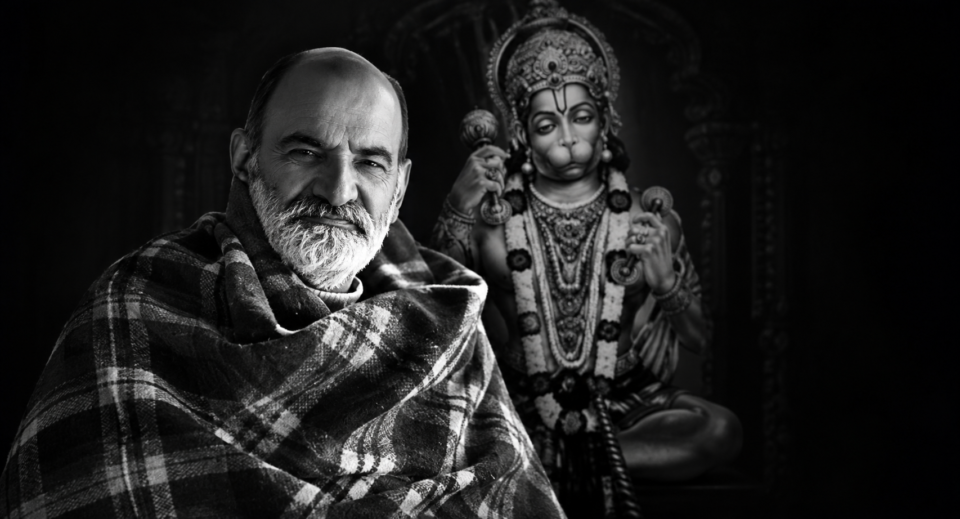
The economists will study the box-office curve. The strategists will study the soft-power dividend. But the deepest lesson is the simplest one, and it is the one Maharaj-ji himself would have offered, barefoot, with a blanket around his shoulders and a smile that asked nothing in return:
A nation that remembers how to love its own soul has already found the only wealth that cannot be taken from it.
Jai Siya Ram. Jai Hanuman.
