

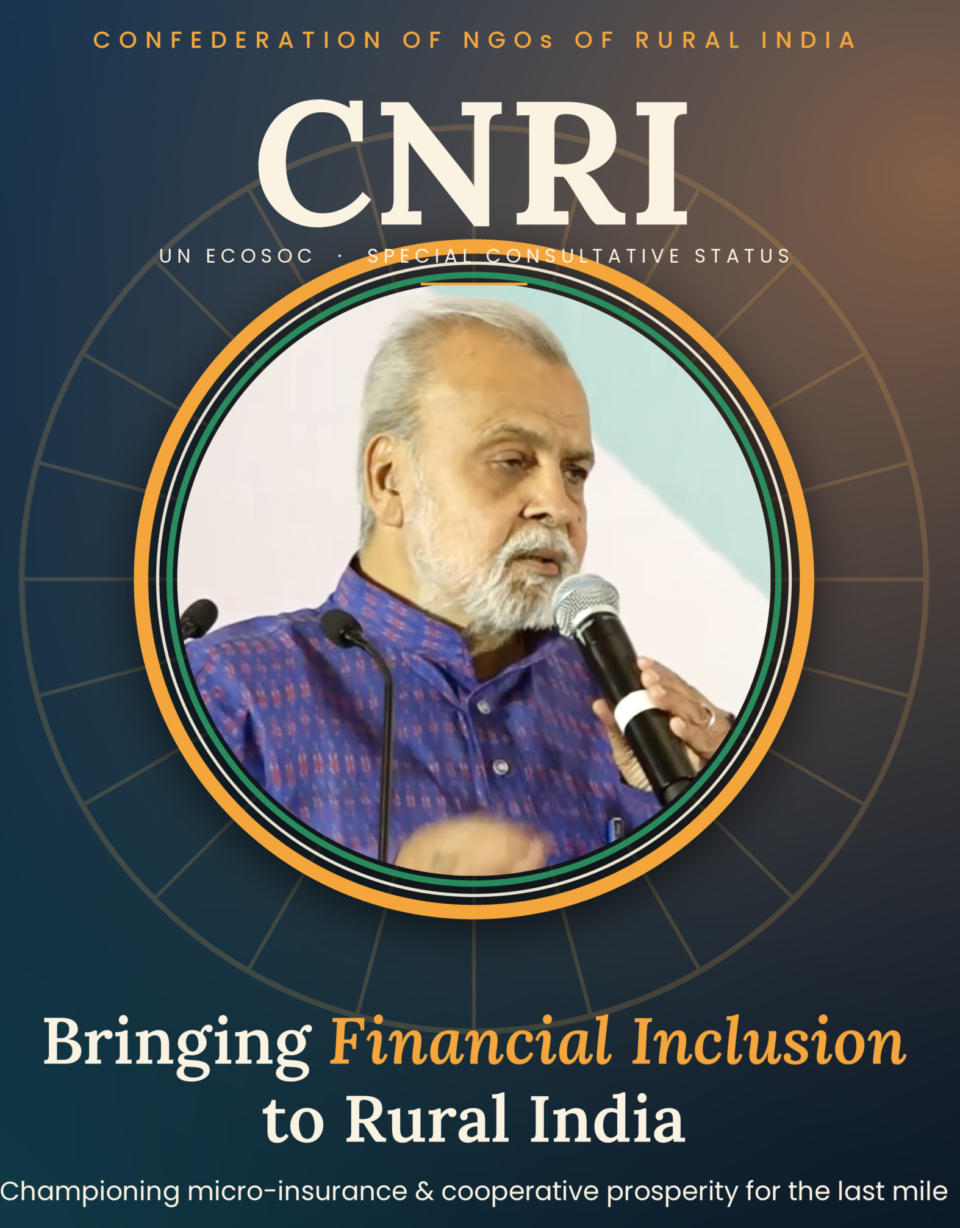
By Raghupati Singh : Executive Chairman CNRI
When the Organisation for Economic Co-operation and Development frames its mission on financial consumer protection, education and inclusion, it makes a deceptively simple argument: that empowering and protecting ordinary people in their everyday dealings with money is the foundation of fairer, more inclusive financial markets, and of individual well-being itself. For the OECD, this is a matter of research, policy analysis and international co-operation. For those of us who have spent two decades walking the unpaved roads of rural India, it has always been a matter of survival, dignity and justice.
As the Confederation of NGOs of Rural India (CNRI) completes twenty years of service, the OECD’s language gives us a useful mirror. It lets us measure a grassroots journey against a global standard — and to say, without exaggeration, that the work of taking financial awareness to the last village has been at the heart of what CNRI set out to do from the very beginning.
The gap that defined the mission
Two decades ago, the Indian countryside was not short of hardworking hands or fertile land. It was short of information. A farmer who could read the sky could not read a loan agreement. A woman who ran a household budget on a few hundred rupees had never been inside a bank branch. The moneylender’s ledger, not the passbook, governed rural credit. Predatory lending, opaque interest, mis-sold insurance, chit-fund frauds and, more recently, digital scams have all fed on the same vulnerability: a citizen unequipped to protect themselves in their dealings with finance.
This is precisely the vulnerability the OECD identifies when it speaks of the need to empower and protect the financial consumer. CNRI recognised early that in India, that consumer wears a farmer’s turban and a self-help-group member’s saree, and that reaching them would require not glossy campaigns but patient, village-level institution-building.
What CNRI has done
Founded in the spirit that would later crystallise as Sahkar Se Samriddhi — prosperity through cooperation — CNRI built its work on the conviction that financial empowerment cannot be handed down; it must be organised from below. Over twenty years, that conviction has taken several concrete forms.
Carrying financial literacy to the doorstep. Working through a nationwide network of member NGOs, CNRI has helped take the vocabulary of formal finance — savings, interest, insurance, credit, digital payments and, crucially, fraud — into villages that no advertising ever reached. [Insert here CNRI’s own verified figures: number of member organisations, districts covered, literacy camps or beneficiaries reached.]
Strengthening the cooperative spine. From the Primary Agricultural Credit Societies at the base to the apex institutions above them, CNRI has consistently argued that cooperatives are India’s most authentic vehicle for financial inclusion — member-owned, locally accountable, and structurally aligned with the interests of the poor rather than against them. Our advocacy for a cooperative economic architecture, and for reforms such as Bima Swaraj — bringing the protection of insurance within a cooperative framework — flows directly from this belief.
Protecting the rural consumer. Inclusion without protection is a trap. A villager pushed into a loan they cannot service, or an insurance policy they never understood, is worse off than before. CNRI has worked to make rural households aware of their rights, wary of mis-selling, and alert to the newest generation of digital and cyber-enabled financial fraud that now targets the very people who have only just come online.
Putting women at the centre. The self-help group has been the quiet revolution of rural India, and financial confidence its most enduring dividend. CNRI’s engagement with women’s collectives has treated financial literacy not as a lecture but as a lever — one that turns a saver into an entrepreneur and a beneficiary into a decision-maker.
Bringing the grassroots voice to policy. Holding Special Consultative Status with the United Nations Economic and Social Council, and engaging with national policy through platforms including the Prime Minister’s High-Power Committee on MSP, crop diversification and natural farming, CNRI has carried the perspective of the rural poor into rooms where financial and agricultural policy is actually made.
Standing in a global network
It is here that CNRI’s association with the OECD-led international community on financial education becomes significant — not as a badge, but as a bridge. The OECD’s International Network on Financial Education (INFE) brings together public authorities and organisations from across the world to compare what works, to build common standards, and to lift financial literacy as a shared global priority.
For an organisation rooted in the villages of India, a seat in that conversation matters for two reasons. First, it lets the hard-won lessons of the Indian countryside — that literacy must be delivered through trusted local institutions, that women’s collectives are transmission channels for change, that inclusion and protection are inseparable — inform a global body of knowledge. Second, it allows the best international thinking on consumer protection and financial education to be translated back into terms a Gram Panchayat can use. India is home to one of the world’s largest populations of newly banked citizens; what we learn here is not a local footnote but a global reference point.
The unfinished agenda
Twenty years is a milestone, not a destination. The frontier of financial empowerment has moved. Where once the challenge was to open a bank account, today it is to protect a first-time smartphone user from a fraudulent link. Where once the concern was access to credit, today it is the responsible design of digital lending. The OECD’s insistence that financial well-being requires both education and protection is, if anything, more urgent in the age of the algorithm than it was in the age of the ledger.
CNRI’s task for the next twenty years is therefore clear: to deepen financial literacy into financial resilience, to make the cooperative the natural home of inclusive finance, and to ensure that as rural India goes digital, no citizen is left to face the market alone and uninformed.
The measure of our first two decades is not in reports filed or forums attended. It is in the farmer who now questions an interest rate, the woman who now signs her own loan, the family that now recognises a scam before it strikes. That is what empowering the masses means. And that, in the end, is the difference between a financial system that is merely open and one that is genuinely just.
The author is Executive chairman with the Confederation of NGOs of Rural India (CNRI) which is Affliated member of International Network of Financial Education led by OECD
