

The Riverbed of Viksit Bharat: Why the Saptadhara Was Made for the Cooperative Economic Framework
Bharatonomics | Binod Anand
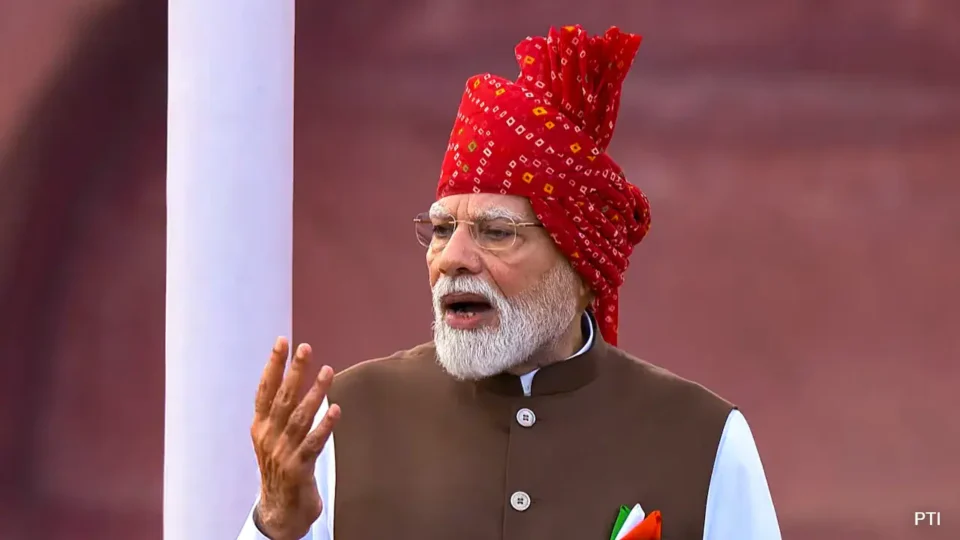
From the ramparts of the Red Fort on our 80th Independence Day, the Prime Minister reached back into civilisational memory and forward into 2047 in a single breath. He recalled the age when India’s strength was known to the world as the Sapta Sindhu — the seven rivers — and then called upon the nation to summon a new current for a developed India: the Shakti ki Saptadhara, the seven streams of strength. Manufacturing. Agriculture and food processing. Technology and innovation. Gati Shakti. Defence. The green and blue economy. Soft power. Seven streams to carry us to Viksit Bharat.
It was a vision of national capability. But every student of rivers knows a simple truth: a stream is only as useful as the channel that carries it. Water that has no bed spreads thin and disappears into sand; water that finds a channel nourishes a civilisation. The Saptadhara names what strength India must build. It does not, by itself, answer how that strength reaches the last field, the last loom, the last fisherfolk hamlet. That question — the question of delivery, of ownership, of who actually holds the surplus at the base of the pyramid — is answered by the framework I have spent my working life arguing for: the Cooperative Economic Framework (CEF).
My proposition is straightforward. Cooperation is not an eighth stream competing with the seven. Cooperation is the riverbed — the channel and the confluence, the sangam — through which all seven streams flow down to the citizen and reach him not as a beneficiary but as an owner. The Saptadhara and the cooperative model are not two agendas to be reconciled. One was made for the other.
Let me walk the seven streams and show why.
One — Manufacturing that people own
The Prime Minister wants India to become a trusted node in the global supply chain, from design to manufacturing. The instinct is to picture large factories. But India’s manufacturing strength has always had a second, quieter engine: producer companies, industrial and artisan cooperatives, weavers’ and handicraft societies, common facility centres shared across an MSME cluster. When the shop floor is cooperatively owned, value addition does not leak upward to a distant balance sheet — it stays in the district. A cooperative common facility centre lets a hundred small units access the machinery none of them could buy alone. This is Atmanirbharta with equity built in. Scale the Amul logic beyond milk, and you have manufacturing that lifts the producer, not merely employs him.
Two — Agriculture: the stream that is already a river of cooperation
Here the Saptadhara meets its most natural ally, because Indian agriculture is already the world’s largest cooperative theatre. From our village PACS to our FPOs, from the dairy revolution NDDB built to the sugar and oilseed federations, the farmer’s strength has always been a pooled strength. As a member of the Prime Minister’s High-Power Committee on MSP, Crop Diversification and Natural Farming, I see daily that the difference between a good farm policy and a delivered farm policy is almost always the institution at the last mile. Food processing — the Saptadhara’s second emphasis — is where the margin lives, and it is precisely where cooperatives let the grower capture what today goes to the intermediary. A farmer who owns a share of the processing plant is a farmer who eats twice from the same harvest.
Three — Technology as a commons, not a moat
India’s genius in this decade has been to treat digital capability as public infrastructure — UPI, the identity and data stack, ONDC. Digital Public Infrastructure is, in spirit, a cooperative idea: shared rails that no one monopolises and everyone builds upon. The natural extension is to put that stack in cooperative hands. We are already watching it happen — core-banking-as-a-service models such as the “Bank in a Box” rollout for urban cooperative banks are bringing thousands of small institutions onto modern digital rails at a cost each could never bear alone. Technology becomes a stream of strength for the many, and not a moat for the few, only when it is owned in common. That is a cooperative sentence disguised as a technology one.
Four — Gati Shakti at the last mile
Connectivity does not end at the highway or the freight corridor; it ends at the village godown, the cold chain, the collection centre. This is the part of the infrastructure story that cooperatives quietly carry: rural warehousing, transport societies, aggregation points, the multipurpose PACS re-imagined as a service hub for its village. Gati Shakti moves goods; cooperatives are what wait at the end of the line to receive them and add value. Trunk infrastructure without last-mile institutions is a pipe that ends in mid-air.
Five — Defence and the strength of a resilient rear
At first glance this stream seems furthest from cooperation. Look closer. A nation’s defence rests not only on its front but on the resilience of its rear — on rural communities that stay economically strong, informationally alert, and socially cohesive, especially along our borders. Ex-servicemen’s producer cooperatives, dual-use component manufacturing through MSME societies feeding the indigenisation drive, and the broader work of civil-society resilience in an age of fourth-generation warfare all belong to the cooperative domain. An economically self-reliant, cohesive village is itself a unit of strategic depth. Cooperation builds the resilient rear that defence indigenisation needs.
Six — The green and blue economy, owned by those who live in it
This is where the confluence is most visible today. The circular rural economy — turning dung and crop residue into compressed biogas, and the slurry back into fertiliser — is being built cooperatively, from the first cooperative CBG plants to the India–Japan push for a thousand biogas units. Our own Bihar Dairy–CBG Cooperative Mission is designed on exactly this logic: the same society that pools the milk pools the waste, and the farmer earns from both. Extend it to solar cooperatives and, on the blue side, to our fisheries federations, and the green-and-blue stream stops being a corporate ESG line item and becomes an income stream owned by the people who live closest to the land and the water.
Seven — Soft power: India’s cooperative gift to the world
The Prime Minister rightly counts our culture, our craft, our yoga and our creative industries as strength the world already respects. To that list I would add one export the world has barely begun to receive from us: the Indian cooperative model itself. With the United Nations having marked an International Year of Cooperatives, and with a dedicated Ministry of Cooperation advancing “Sahkar Se Samriddhi,” India holds a development template the Global South is hungry for. This is the mission of the World Cooperative Economic Forum — to carry that template abroad the way Davos carries capital and the COP process carries climate diplomacy. Cooperation is not only how we build at home; it is how we lead abroad.
The stream and its channel
Notice what runs through all seven. In every case the Saptadhara supplies the ambition and the cooperative supplies the architecture — the ownership at the base, the surplus retained locally, the self-correcting institution that reaches the citizen the market forgets. This is what I have elsewhere called the economy that heals itself: a framework that resists the fragmenting agents of our age — extractive intermediaries, predatory finance, algorithmic manipulation — not by fighting them one by one, but by rooting economic power where it cannot easily be captured.
The Sapta Sindhu once nourished a civilisation because its waters found their channels and reached the fields. The Saptadhara can nourish Viksit Bharat in exactly the same way — but only if we build the riverbed. That riverbed is cooperation. Seven streams of strength, one channel of ownership, and no field left dry.
Sahkar Se Samriddhi.
