

Binod Anand ,November 12, 2026 ·
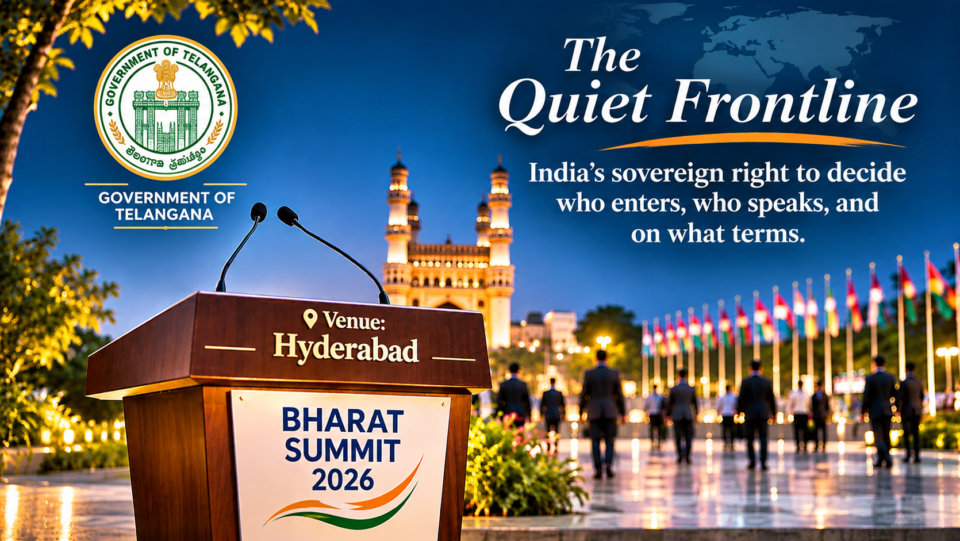
ndia was right to decide who enters its territory for the Bharat Summit, and every major democracy has done the same. This week, the Government of India refused entry to, or cancelled the visas of, roughly 113 to 115 of the 315 foreign speakers invited to the Bharat Summit in Hyderabad. The summit is organised by the Congress party and hosted by the Telangana government.
The reaction was swift. Congress MP Shashi Tharoor called it a sign of an insecure democracy. The Editors Guild of India called it bureaucratic overreach and demanded a reversal. At the time of writing, the Government has not published its reasons.
Voice of Rural India takes a different view. The power to admit or refuse a foreign national is one of the oldest and least disputed powers of a sovereign State. Democracies across the world, including those most often held up as models of free speech, use it regularly and without apology. India has done nothing exceptional. It has done what a confident sovereign democracy is entitled to do.
The law is clear: a visa is a permission, not a right
The entry and stay of foreign nationals in India are governed by the Immigration and Foreigners Act, 2025. A visa issued under it is a permission, and the competent authority may revoke it in accordance with law.
The Supreme Court of India settled the principle decades ago. In Hans Muller of Nurenburg (1955), it held that the Government’s power to expel foreigners is absolute and unlimited. In Louis De Raedt (1991), it held that a foreigner’s fundamental rights stop at Article 21. They do not include a right to reside and settle in India.
Article 19(1)(a), which critics have invoked, is by its terms a guarantee to citizens. A foreign speaker cannot rely on it to demand entry. International law agrees: the International Covenant on Civil and Political Rights guarantees a person the right to enter only their own country.
None of this places the power beyond the Constitution. It must be exercised under law and remains subject to judicial review. Anyone aggrieved can approach the competent authority and, where maintainable, the courts.
The world does exactly the same
The democracies that lecture India most often on free speech are the ones that exercise this power most freely, including against invited speakers and people already granted permission to travel.
| Country | Year | Who was kept out | Stated ground | Outcome |
|---|---|---|---|---|
| United Kingdom | 2026 | Rapper Ye (Kanye West), booked to headline London’s Wireless Festival | Travel authorisation withdrawn after being granted online: presence “not conducive to the public good” | Festival cancelled; Prime Minister backed the decision |
| United States | 2025 | Former EU Commissioner Thierry Breton and four European NGO figures | Potentially serious adverse foreign-policy consequences, over alleged censorship campaigns | Visa bans stand despite protests from France and the European Commission |
| Australia | 2024–25 | US commentator Candace Owens, due on a speaking tour | Character test: risk of inciting discord in the community | High Court unanimously upheld the refusal in October 2025 |
| Germany | 2024 | Former Greek finance minister Yanis Varoufakis and other speakers at a Berlin “Palestine Congress” | Entry and political-activity ban by the Interior Ministry | Challenged in court; some bans later held unlawful |
| United States | 1969–72 | Belgian journalist Ernest Mandel, invited by Stanford and other universities | Statutory exclusion; waiver refused | Supreme Court upheld the exclusion 6–3 |
The last case is the closest parallel to Hyderabad. American professors argued that their own free-speech rights entitled them to hear Mandel in person. In Kleindienst v. Mandel, the US Supreme Court disagreed. It held that where the executive acts on a “facially legitimate and bona fide reason”, courts will not second-guess it. That precedent still governs American immigration law today and was relied on in Trump v. Hawaii (2018).
The German case teaches the other half of the lesson. Where a government goes too far, the remedy is in the courts, not in the headlines. That remedy is equally open in India.
Why this matters to rural India
The contest for a nation’s security is no longer fought only on its borders. It is also fought on a quiet frontline of disinformation, organised narrative campaigns and the exploitation of social divisions. This is the terrain of Fourth-Generation Warfare.
Rural India is on the front line of that contest, though it rarely knows it. A narrative launched from an international stage in a city reaches a village through a forwarded video within hours. By then, the context is lost and only the grievance travels. Farmers, labourers and young people are the intended audience of such campaigns, and they have the fewest tools to test what they are told.
This is why the question of who speaks from Indian platforms, and on what terms is not abstract. When the Government weighs whether a large gathering of foreign speakers could become a platform for narratives prejudicial to India’s sovereignty or security, it is doing exactly what the UK did at Wireless and what Australia did with its character test. It is protecting the public from foreseeable harm before it happens, rather than after.
To be clear, Voice of Rural India makes no allegation against any individual invitee or against the organisers. The grounds in each case are for the competent authorities to determine and, if challenged, for the courts. Our point is about the principle: a sovereign State is entitled to make that assessment, and it is better made at the border than after the damage is done.
Answering the critics
“This is an attack on press freedom.” Press freedom protects what is published and broadcast in India. It does not confer a right on any foreign national to enter the country. Not one of the invitees has been prevented from writing, speaking online or being published in India. The summit itself went ahead, with around 200 delegates present.
“They already had clearance and visas.” A permission granted can be reviewed and withdrawn. The UK withdrew Ye’s travel authorisation after it had been issued, and nobody called Britain a dictatorship for it. Different arms of a government assess different risks. Security review by the Home Ministry is a safeguard, not a scandal.
“It damages India’s image.” Every democracy in the table above paid a short-term price in criticism. None of them treated that criticism as a reason to surrender the decision. A country that bends its border policy to avoid bad headlines does more damage to its standing than one that holds its ground.
“The reasons should be public.” This is the critics’ strongest point, and it deserves a fair hearing. Transparency builds trust, and we would welcome disclosure wherever it is consistent with security. But security assessments are often confidential everywhere, and the right forum to test them is the court, not the press release.
A confident democracy guards its door
India welcomes the world. It hosts thousands of foreign scholars, journalists and delegates every year, and it will continue to. Debate and criticism, including sharp criticism of the Government, remain fully protected for every citizen.
But openness is not the same as having no door. Washington, London, Canberra and Berlin all decide who may enter, and their courts have repeatedly confirmed that right. By making the same sovereign decision for the Bharat Summit, India has acted as a mature democracy should: within the law, subject to the courts, and with its national interest in view.
On the quiet frontline, a resilient civil society is India’s strongest shield on the path to Viksit Bharat 2047.
Right of reply: every organisation and person named here is invited to respond at cnrigreenworld@gmail.com. Responses will be published in full.
