

By Binod Anand
 \
Nov 12, 2026
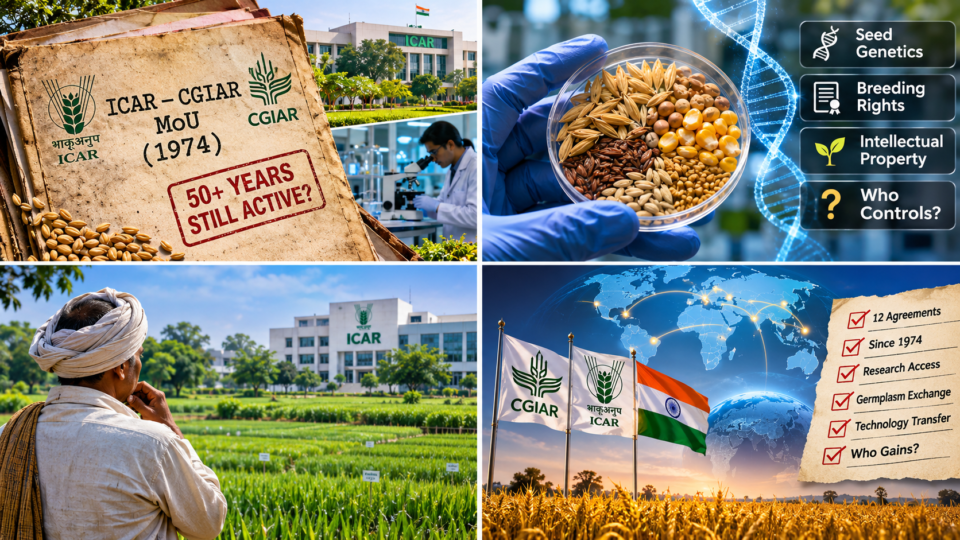
As India marches towards Viksit Bharat 2047, its agricultural research remains trapped in the past. The Indian Council of Agricultural Research (ICAR) continues to operate under twelve agreements with foreign-governed research centres, the oldest dating back to 1974. While India speaks of agricultural self-reliance, its premier research institution remains entangled in outdated international arrangements and recycled programmes. The uncomfortable question is: who controls India’s agricultural research, who owns its scientific outcomes, and who ultimately profits from Indian farmers’ land, seeds and knowledge? What is projected as scientific cooperation risks becoming a polite transfer of India’s agricultural sovereignty.
Everything was reformed except this
India has rebuilt almost every major institution since these agreements were signed. Farm research is the exception.
| Field | Reform | Year |
| Planning | Planning Commission replaced by NITI Aayog | 2015 |
| Centre–State relations | Sarkaria Commission report | 1988 |
| Administration | Two Administrative Reforms Commissions | 1966, 2005 |
| Economy | Liberalisation and delicensing | 1991 |
| Taxation | Goods and Services Tax | 2017 |
| Insolvency | Insolvency and Bankruptcy Code | 2016 |
| Securities market | SEBI given statutory powers | 1992 |
| Stock trading | Screen-based trading, then dematerialisation | 1994, 1996 |
| Agricultural research MoUs | ICAR agreements with IRRI and CIMMYT, still in force | 1974 |
The Finance Ministry and the market regulators reopened their own rulebooks again and again. ICAR has been studied by committees, but we could find no published review of its twelve agreements with the CGIAR centres. They have simply been renewed.
These MoUs are not ceremonial. Through their work plans they steer what Indian scientists breed, test and release. Yet the list on ICAR’s website shows only a serial number, a partner and a date. It does not show what India promised, what it has paid, or what it has received.
What the twelve agreements are
The agreements are framework MoUs between ICAR and centres of CGIAR, the Consultative Group on International Agricultural Research. The first two, with CIMMYT (wheat and maize, Mexico) and IRRI (rice, Philippines), were signed on the same day: 15 March 1974. ICAR’s own ICAR-CGIAR Annual Report 2019-20 says they cover exchange of germplasm, training and study visits, joint experiments and publications.
The real content sits one level below, in work plans renewed every three to five years. These decide which crops, traits and districts get attention. The work plans are not posted alongside the MoU list.
| Centre | Mandate | Headquarters | MoU signed |
| IRRI | Rice | Philippines | 15 March 1974 |
| CIMMYT | Wheat, maize | Mexico | 15 March 1974 |
| CIP | Potato, sweet potato | Peru | 17 Nov 1975 |
| ICRISAT | Dryland cereals, pulses, groundnut | Hyderabad, India | 15 July 1976 |
| ICRAF (World Agroforestry) | Agroforestry | Kenya | 31 Oct 1985 |
| ICARDA | Dry-area crops: lentil, chickpea, barley | Lebanon | 15 Dec 1986 |
| CIAT | Cassava, beans, forages | Colombia | 17 June 1988 (website) or 1998 (annual report) |
| IFPRI | Food policy | USA | 1 Aug 1988 |
| WorldFish (WFC) | Fisheries, aquaculture | Malaysia | 15 July 1996 |
| Bioversity International | Crop diversity, genebanks | Italy | 19 July 1996 |
| IWMI | Water management | Sri Lanka | 25 Nov 1996 |
| ILRI | Livestock | Kenya | 7 June 2004 |
Two details in ICAR’s own record deserve notice. The CIAT date differs by a decade between the website and the annual report. And the website entry for ICRAF reads “CAR and ICRAF”, a typing error left standing on an official register of international agreements.
The sovereignty question
The charge is not that the agreements are secret. It is that decisions about Indian land, Indian seed and Indian research priorities are taken through instruments that Parliament, state governments and farmers cannot inspect or enforce. Four documented facts support it.
Institutions on Indian soil sit outside Indian courts.
The Government of India notified ICRISAT under the United Nations (Privileges and Immunities) Act, 1947 in October 1972. In G. Bassi Reddy v. ICRISAT the Supreme Court held that the institute is immune from suit and that a writ under Article 226 cannot be issued against it. The Union Cabinet gave the same status to CIMMYT’s Borlaug Institute for South Asia (BISA) in 2011.
India pays and hosts, but does not govern.
For IRRI’s South Asia Regional Centre at Varanasi, the Agriculture Ministry provides land, laboratories and offices on the campus of a national seed institute. The centre, as the Cabinet decision of July 2017 records, operates under the IRRI Board of Trustees, which appoints its director.
The nodal ministry is sometimes bypassed. ICAR’s own annual report notes that CG centres obtain projects from other ministries and from states, including under RKVY, “some without informing DARE”, the department responsible for international farm-research collaboration under the Allocation of Business Rules. When the national research council records in print that it is not told, the complaint about oversight is no longer an outsider’s.
Germplasm leaves on terms farmers never negotiated. The best-known case is the collection of about 19,000 traditional rice varieties assembled in Madhya Pradesh by Dr R.H. Richharia in the 1970s. Critics have long alleged that this material reached IRRI in the early 1980s after his institute was closed; GRAIN and others documented a later attempt, in 2002, to share the same collection with Syngenta. These accounts come from campaigners and from Richharia himself, and official versions differ. The dispute has never been settled by a public inquiry, which is itself the point.
Who gains
Four groups gain, and the Indian farmer is only one of them.
The donors who set the agenda. CGIAR is financed mainly by a handful of Western governments and one private foundation. A CGIAR resource-mobilisation paper puts 2018 contributions at US$126 million from the United States, US$98 million from the Bill & Melinda Gates Foundation and US$58 million from the United Kingdom. India’s contribution that year was about ₹50 crore, roughly US$7 million. India holds the South Asia seat on the System Council; it does not hold the purse.
The centres themselves. They receive land, buildings, tax and legal privileges, and access to one of the world’s largest pools of trained agricultural scientists and multi-location trial sites. Most of India’s money goes through “Window 3”, which funds projects carried out by the centres. Indian public money therefore pays international centres to work in India, alongside ICAR institutes working on the same crops.
The private seed and food industry. ICAR’s report states that about two-thirds of pearl millet hybrids grown in India contain ICRISAT-bred parent lines, and that more than 50 sorghum hybrids covering over 2 million hectares rest on ICRISAT parents. Several of the hybrids it names are company products. The report also records seed, food and oil firms attending ICRISAT’s groundnut planning meetings to help define “product profiles”. Publicly funded breeding material becomes a privately sold hybrid, and the farmer buys the seed every season.
Corporate funders at the margin. CIMMYT’s own 2020 funder list names the Gates Foundation and USAID as its two largest project funders and includes Bayer’s Mexican arm among others. None of this is illegal. It does mean the line between public international science and commercial interest is thinner than the MoU table suggests.
The genebank network and Svalbard. CG centres hold seed collections gathered from farmers’ fields across the developing world, India included, and send duplicates to the Svalbard Global Seed Vault in Norway. ICAR’s report records that CIAT alone has deposited nearly 31,000 samples there. The Crop Trust, which finances these genebanks and supports the vault, lists among its donors the Gates Foundation, the Syngenta Foundation and CropLife International, the trade body of the pesticide and seed industry. The custodians of the world’s seed heritage are part-funded by the companies that sell seed and chemicals back to farmers.
What India has given
India paid about ₹320 crore to CGIAR and its centres in the seven years to 2019-20, by ICAR’s own table. That is the only consolidated figure in the public domain, and it excludes land, buildings, tax concessions and state-government projects.
| Year | Window 1, membership (₹ crore) | Window 3, centre projects (₹ crore) |
| 2013-14 | 4.52 | 31.86 |
| 2014-15 | 4.70 | 34.50 |
| 2015-16 | 4.88 | 40.00 |
| 2016-17 | 5.13 | 42.99 |
| 2017-18 | 4.76 | 45.63 |
| 2018-19 | 5.16 | 45.48 |
| 2019-20 | 5.16 | 45.47 |
| Total | 34.31 | 285.93 |
Source: ICAR-CGIAR Annual Report 2019-20, Table 2.
The contributions in kind are larger and harder to price.
| What India gave | Detail |
| Land for ICRISAT | A 1,390-hectare campus at Patancheru, Hyderabad, provided by the Government of India under the 1972 agreement |
| Land for BISA | Sites at Ludhiana, Pusa and Jabalpur; Bihar pledged 200 acres at ₹1 per acre |
| Space for IRRI | Land, laboratories and offices at the National Seed Research and Training Centre, Varanasi |
| Offices | Regional and country offices of ten centres, most in the NASC Complex, Pusa, New Delhi |
| Legal privileges | UN-style immunities and tax privileges for ICRISAT (1972) and BISA (2011) |
| Germplasm | 44,005 samples exported to CG centres in 1976–2019, plus 7,41,485 samples of ICRISAT crops cleared for export through Hyderabad |
| Scientific labour | Multi-location testing of 27.8 lakh nursery and trial samples by Indian institutes and universities |
What we could not find in the public domain: the text of the twelve MoUs, the current work plans, year-wise payments after 2019-20, the Centre’s outlay on the Varanasi centre, the market value of land transferred, and the total of state-level projects awarded to CG centres.
What the farmer got, and what he pays
The farmer did receive varieties, and ICAR lists them. What he never received is a say in the terms, or relief from the rising cost of the farming model that came with them.
| Crop | Benefit recorded by ICAR |
| Wheat | Dwarf varieties of CIMMYT parentage doubled production between 1966 and 1971 |
| Rice | Swarna-Sub1, the first flood-tolerant variety, and other stress-tolerant lines with IRRI |
| Chickpea | Varieties from the ICRISAT partnership made up 53% of the national breeder-seed indent for 2019-20 |
| Pigeonpea | 52% of the breeder-seed indent for 2020 |
| Pearl millet, sorghum | Over 300 varieties and hybrids released with ICRISAT across its mandate crops |
| Lentil, kabuli chickpea, barley | 15, 7 and 11 varieties respectively using ICARDA material |
| Potato | Eight varieties with CIP; two processing types cover over 1,00,000 hectares |
| Cassava | Seven mosaic-resistant varieties from CIAT material |
India also imported 2,31,271 germplasm accessions from CG centres between 1976 and 2019, five times what it formally exported to them. Over 1,600 Indian scientists were deputed abroad in five years under ICAR’s foreign collaborations as a whole.
Set against this is the bill. The model these centres promoted depends on purchased seed, fertiliser, pesticide and pumped water every season. Hybrid seed cannot be saved from the harvest, so it must be bought again each year, often from a company using publicly bred parent lines. The cost of cultivation keeps climbing while the farmer’s share of the gain is never measured.
No published audit sets India’s cumulative contribution in money, land and germplasm against the income gain to farmers, crop by crop. ICAR’s report itself gives two different counts, 316 and 362, for varieties released with ICRISAT. A partnership that cannot count its own results cannot claim to have served the farmer well.
The other side
Defenders of the partnership make a serious case, and readers should weigh it.
- The agreements are approved, not smuggled in. Each MoU and work plan goes through the Government of India, and Cabinet approved BISA and the Varanasi centre in the open. The list this article starts from is published by ICAR itself.
- India is inside the tent. The Secretary, DARE and Director General, ICAR sits on the CGIAR System Council, is ex-officio Vice-Chair of ICRISAT’s Governing Board and has served on the boards of IRRI, ICARDA and Bioversity.
- The germplasm balance favours India. On ICAR’s figures India has drawn far more accessions from CG genebanks than it has sent. Genebank material is held in trust under the FAO plant treaty, to which India is a party, and cannot be patented in the form received.
- Immunities are standard. Host-country privileges are the normal price of hosting an international organisation, and India extends them to many UN bodies.
- The money is small. About ₹50 crore a year is a tiny share of ICAR’s budget, against varieties that now dominate breeder-seed demand in pulses and millets.
- The Richharia account is contested. It rests largely on his own testimony and on campaign literature; no official record has established it.
On Svalbard, defenders add that seed deposited in the vault remains the property of the depositor, and only the depositor can withdraw it.
The dispute, then, is less about whether India benefited than about terms, transparency and who decides. On those questions the public record is thin, and the remedy is disclosure.
What should be done
The government must take the bull by the horns. It reformed planning, taxation and the capital markets; it can reform this.
Seven steps would free Indian farm science from agreements written for another era.
- Set a sunset. Declare that all twelve MoUs lapse within two years unless renegotiated on new terms and placed before Parliament’s standing committee on agriculture.
- Publish the texts. Place every MoU and current work plan on the ICAR website, in English and Hindi.
- Table the accounts. Lay before Parliament an annual statement of every rupee, acre and privilege extended to each centre by the Centre and the states.
- Enforce the single window. No ministry or state should award a project to a CG centre without DARE’s recorded clearance.
- Audit the germplasm. Commission NBPGR and the National Biodiversity Authority to report what Indian material is held in CG genebanks and in Svalbard, on what terms, and what benefit-sharing has flowed back.
- Protect the farmer’s stake. Where a private hybrid is built on publicly bred parent lines, require disclosure of pedigree and a fair seed price.
- Fund ICAR first. Money for a centre’s project in India should be matched by equal support to the ICAR institute or state university working on the same crop.
Viksit Bharat needs a farm-research system that answers to the Indian farmer and to Parliament. Agreements signed for the India of 1974 cannot be allowed to govern the India of 2047.
Right of reply: every organisation and person named here is invited to respond at voricnri@gmail.com. Responses will be published in full.
